


 Français
 2026.06.16
N-Type Solar Panel Wholesale: TOPCon & HJT Buying Guide for Distributors
Content
- 1 Why N-Type Solar Panels Are Taking Over the Wholesale Market
- 2 TOPCon vs HJT: Which N-Type Technology Should You Source?
- 3 Key Performance Metrics That Matter in Wholesale Buying
- 4 How to Choose a Reliable N-Type Solar Panel Wholesale Supplier
- 5 Certifications and Compliance for Global Wholesale Orders
- 6 What to Expect When Placing a Wholesale Order
- 7 The Wholesale Advantage: Why Bulk N-Type Orders Make Financial Sense
Solar panel efficiency records have been broken more times in the past three years than in the previous decade combined — and nearly every new benchmark has been set by an N-type cell. For wholesale buyers, that trajectory is no longer a future forecast. It is the market you are buying into right now.
Why N-Type Solar Panels Are Taking Over the Wholesale Market
The shift from P-type to N-type is not a marketing cycle — it is a structural change driven by measurable performance gaps. N-type silicon uses phosphorus as the primary dopant instead of boron, which makes the substrate far less susceptible to light-induced degradation (LID). In practical terms, a P-type PERC module typically loses around 2–3% of its output in the first year; a comparable N-type TOPCon module holds first-year degradation to roughly 1% or below.
Efficiency tells a similar story. Commercial N-type panels now routinely achieve module efficiencies above 22%, with leading TOPCon products reaching 23–23.5% in production lines. P-type PERC has largely plateaued around 20–21%. For a wholesale buyer assembling a 500 kW commercial rooftop or a multi-MW ground array, that 2-percentage-point gap translates directly into fewer panels, fewer mounting structures, and lower labor costs per watt installed.
Temperature coefficient is the third pillar. N-type cells lose less power as operating temperatures rise — typically around –0.30%/°C versus –0.35% to –0.40%/°C for P-type. In warm climates, this difference compounds across every summer day of a 25-year project life.
The wholesale market has already moved. Tier 1 manufacturers shifted the majority of their new capacity to N-type lines by 2024, and pricing has converged close enough with P-type PERC that the performance premium now costs almost nothing extra at scale.
TOPCon vs HJT: Which N-Type Technology Should You Source?
Not all N-type panels are built the same way. The two dominant technologies — TOPCon (Tunnel Oxide Passivated Contact) and HJT (Heterojunction) — suit different project profiles, and understanding that distinction matters when placing a large order.
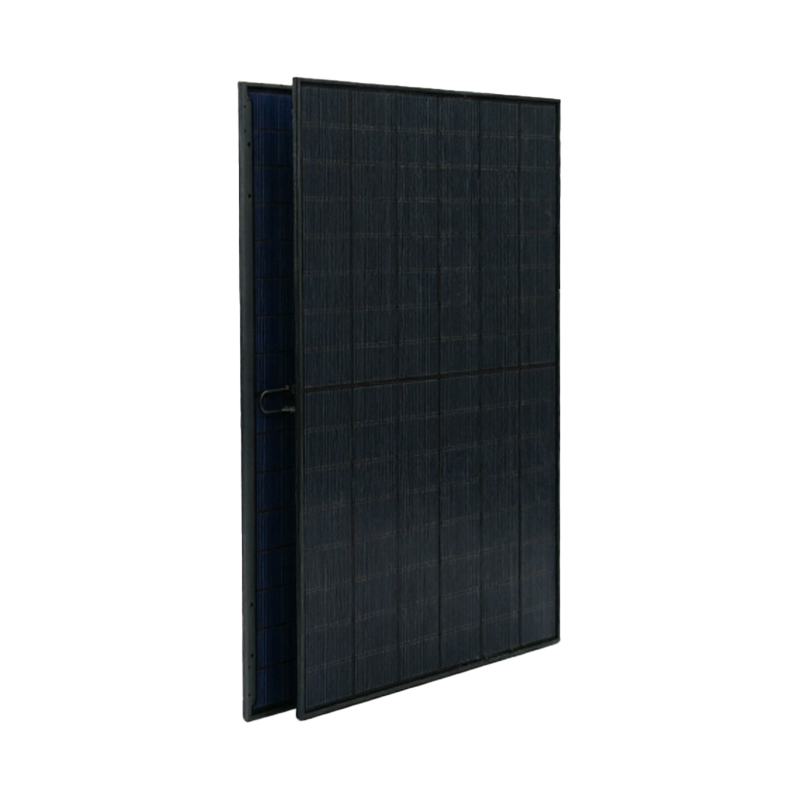
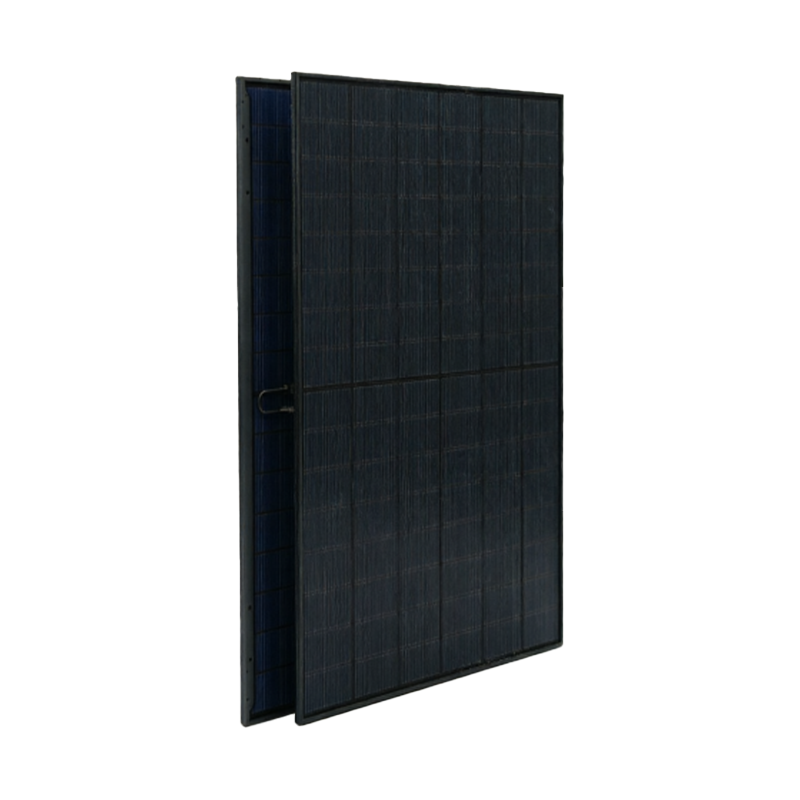
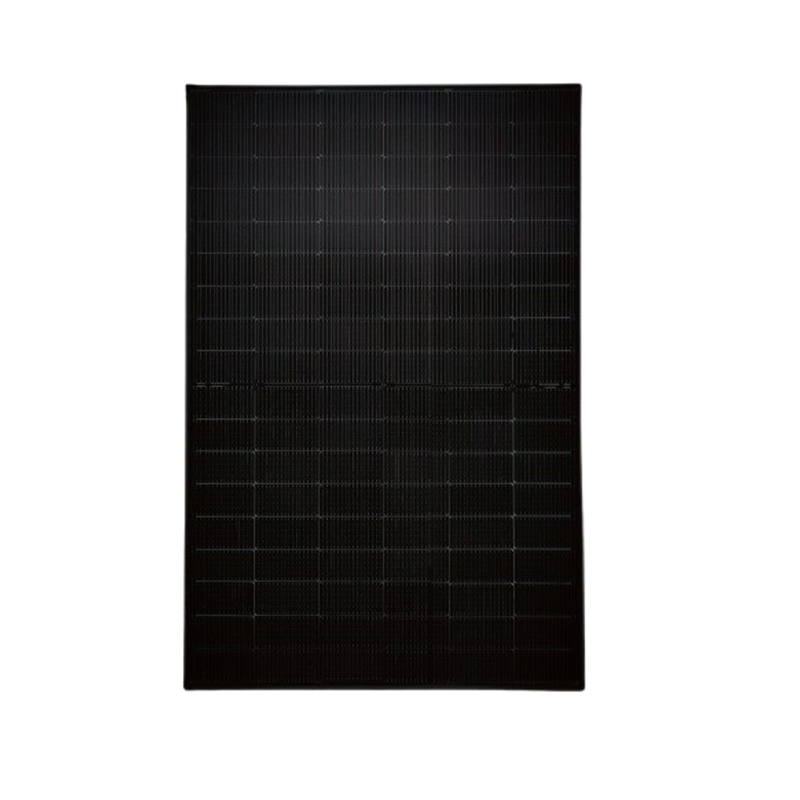
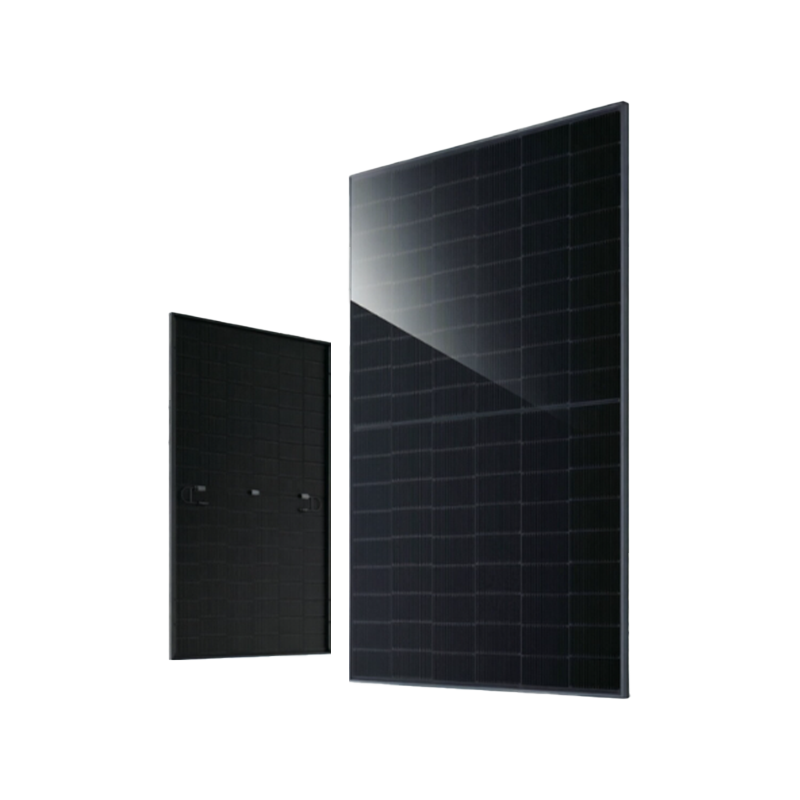
TOPCon adds a thin tunnel oxide and doped polysilicon layer to the cell's rear contact, dramatically reducing recombination losses. It is manufactured on equipment largely compatible with existing PERC lines, which is why Tier 1 manufacturers have scaled it aggressively. Lead times are shorter, pricing is more competitive, and availability at container volumes is reliable. Most commercial and utility projects sourced wholesale today are TOPCon. Longi N-type solar panels for utility and rooftop projects and Jinko TOPCon modules with high bifaciality ratings are among the most widely distributed TOPCon lines globally.
HJT sandwiches the crystalline silicon wafer between amorphous silicon layers, achieving the lowest temperature coefficients and the best low-light response of any mass-produced cell type. Efficiencies above 23.5% are achievable in commercial production. The trade-off: HJT requires dedicated manufacturing equipment and carries a higher per-watt cost. It is the right choice for space-constrained rooftops where every square meter must deliver maximum output, or for markets where energy density commands a price premium.
For most wholesale buyers targeting general commercial or utility-scale projects, TOPCon delivers the best combination of performance, price, and supply security. HJT makes sense as a premium line for specific high-value segments within a broader portfolio.
Key Performance Metrics That Matter in Wholesale Buying
A datasheet is only useful if you know which numbers actually affect your project economics. Here are the parameters worth scrutinizing before signing a wholesale purchase order.
- Module efficiency (%) — Determines how much power you extract per square meter. Higher efficiency means fewer modules per kW, which reduces BOS costs. For N-type TOPCon, target ≥22%; for HJT, ≥23%.
- First-year degradation (%) — Look for ≤1.0% for N-type. This directly affects bankability and the accuracy of your energy yield projections over a 25-year PPA or loan term.
- Annual degradation rate (%/year) — Premium N-type products warrant ≤0.4%/year. At that rate, a panel still delivers over 87% of its rated output at year 30.
- Temperature coefficient of Pmax (%/°C) — The closer to zero, the better. N-type cells at –0.28% to –0.32%/°C outperform PERC in any warm-climate deployment.
- Bifaciality factor (%) — Most N-type panels are bifacial, capturing reflected irradiance from the ground. A bifaciality factor of 70–80% is standard; some HJT products exceed 85%. Actual rear-side gain depends on albedo and installation height.
- Power tolerance (+/– W) — Insist on positive-only or tight positive tolerance (0/+5W). Negative tolerance means you may receive modules rated below nameplate — a real risk when buying large batches.
When comparing datasheets across suppliers, normalize everything to the same STC (Standard Test Conditions) baseline. Field conditions vary; the datasheet is your controlled reference point.
How to Choose a Reliable N-Type Solar Panel Wholesale Supplier
Wholesale purchasing concentrates both the upside and the risk. Choosing the wrong supplier at container volume is a costly mistake that takes months to unwind. The following criteria separate reliable wholesale partners from cheap-on-paper options.
Tier 1 bankability. Bloomberg NEF's Tier 1 list and similar bankability assessments evaluate manufacturers on financial strength, production scale, and track record. Tier 1 status matters when projects require project finance — lenders and insurers are far more comfortable with modules from bankable manufacturers. JA Solar PV panels for commercial installations carry this bankability profile across a broad N-type lineup.
Manufacturing transparency. Ask for factory audit reports or third-party inspection results. A supplier willing to share these documents has less to hide than one who deflects the request. For large orders, on-site or pre-shipment inspection by an independent inspector (SGS, Bureau Veritas, TÜV) is standard practice and worth the cost.
Warranty structure. A 25-year linear power warranty with the manufacturer still in business to honor it is very different from a 25-year warranty on paper. Review the warranty terms: is there a separate product (materials/workmanship) warranty? Who is the warrantor — the manufacturer or a local subsidiary? What is the claims process?
Supply consistency. For ongoing project pipelines, ask about allocation certainty — specifically, can the supplier commit to module specifications and delivery windows across multiple purchase orders? Price is secondary to reliability if your project schedule depends on a specific delivery date.
Certifications and Compliance for Global Wholesale Orders
Certifications are not bureaucratic formalities — they determine whether your modules can be legally installed in a given market and whether your project qualifies for grid connection, insurance, and incentive programs.
The core certifications to verify before placing any wholesale order:
- IEC 61215 / IEC 61730 — The baseline international standards for crystalline silicon module design qualification and safety. Required for virtually every market globally.
- UL 61730 — The North American equivalent, required for projects in the United States and Canada. Also required for CEC listing in California.
- MCS (Microgeneration Certification Scheme) — Required for UK residential and small commercial installations claiming incentive payments.
- CE Marking — Required for sale and installation across the European Union.
- CEC Listed (California Energy Commission) — Mandatory for incentive eligibility under US federal and California state programs.
Astronergy solar modules with verified Tier 1 certifications hold multi-market certification coverage, which simplifies compliance for buyers operating across geographies. Always confirm that the specific model number and wattage you are ordering — not just the brand — appears on the relevant certification database.
What to Expect When Placing a Wholesale Order
Understanding the procurement process saves time and prevents surprises. Here is the typical sequence for a wholesale N-type solar panel order:
- Inquiry and quote — Provide the module type, target wattage, quantity (in units or MW), delivery destination, and required certifications. A reputable supplier will return a formal quote within 24–48 hours for standard product lines.
- Sample review — For new supplier relationships or new product lines, request samples for independent flash testing and visual inspection before committing to a full order.
- Pro forma invoice and deposit — Most manufacturers require a 30% deposit (T/T) to schedule production. Confirm the production allocation date in writing.
- Production and QC — Standard lead time for in-stock items is 7–15 days to shipment. For made-to-order quantities, allow 3–6 weeks. Arrange third-party pre-shipment inspection at this stage if your order size warrants it.
- Shipping and logistics — Sea freight is standard for pallet or container quantities. Confirm Incoterms (FOB, CIF, DDP) and customs clearance responsibilities upfront, especially for US orders where AD/CVD tariff exposure varies by country of origin.
- Balance of payment and documentation — Remaining payment is typically due against shipping documents (B/L, commercial invoice, packing list, certificates of origin).
If your project requires hybrid inverters compatible with high-wattage N-type arrays, coordinate the inverter specification alongside the panel order — string sizing and MPPT voltage ranges must be matched to the module's electrical parameters.
The Wholesale Advantage: Why Bulk N-Type Orders Make Financial Sense
The economics of wholesale solar procurement are straightforward: volume drives down cost per watt, and lower cost per watt expands project margins or expands the number of projects that pencil out at a given tariff or incentive level.
For distributors and EPC contractors, maintaining a standing inventory of N-type panels — particularly TOPCon in the 580–620W range — allows faster project closure and reduces exposure to spot-market price volatility. Wholesale pricing for N-type TOPCon at container volume currently sits in the range of $0.10–$0.18/W depending on brand tier, certification requirements, and destination market, a level that was unimaginable five years ago for this performance class.
Beyond price per watt, the performance advantage of N-type compounds financially over time. A project using panels with 0.4%/year degradation versus 0.55%/year produces meaningfully more energy over a 25-year operating life — energy that converts directly into additional revenue under a PPA or net-metering structure. The upfront cost difference, already narrow at wholesale volumes, often pays for itself within the first two to three years of operation.
Pairing N-type modules with the right complete solar energy storage solutions further strengthens project economics by enabling time-of-use optimization and grid services revenue — a combination increasingly demanded by commercial and industrial end users.
N-type technology is no longer the premium exception. At wholesale scale, it has become the rational default.







3+ Branch Offices
1+ Factory
Required fields are marked


Copyright @ Hangzhou Seetek New Energy Sci-tech Co., LtD. All rights reserved Solar Energy Storage Solution Solar Energy Storage Products Supplier
