


 Français
 2026.10.16
Building Integrated Photovoltaic Guide: Design, Sourcing and Project Delivery
Content
- 1 What Building Integrated Photovoltaics Actually Means
- 2 The BIPV Forms You Will Most Often Be Asked About
- 3 Comparing BIPV Fairly on Cost and Output
- 4 Electrical Design: Strings, Orientations and Inverters
- 5 BOS, Mounting and Cable Management
- 6 Storage, Load Matching and the Grid Interface
- 7 A Practical Sourcing Checklist for Project Buyers
- 8 Working Through a BIPV Project Without the Guesswork
Building integrated photovoltaic (BIPV) is one of those subjects that sounds futuristic in a brochure and then turns into a very practical conversation on site: who owns the waterproofing detail, which strings land on which MPPT, and what happens when a single glass unit has to be replaced eight years from now. This guide is written for the people who actually have to answer those questions — installers, EPC teams, facade contractors and project buyers who are being asked to price a photovoltaic envelope rather than a conventional rooftop array.
What Building Integrated Photovoltaics Actually Means
Building integrated photovoltaics are PV materials that replace a conventional building element instead of being mounted on top of one. That could be a roof tile, a facade cassette, a spandrel panel, a skylight, a shading fin or a balcony balustrade. The dual role is the entire point of the technology, and also the source of most of its complexity: the product has to behave as a compliant building component first and as a generator second.
The distinction from building-applied photovoltaics (BAPV) is worth keeping sharp when you talk to a client. With BAPV, a racking system is fixed to an existing roof or wall and the module sits above it. With BIPV, the module is the roof or the wall. Everything that follows — structural calculations, fire performance, weathertightness warranties, replacement strategy, access for cleaning — becomes part of the electrical specification rather than a separate building package.
The BIPV Forms You Will Most Often Be Asked About
In practice, a handful of product families cover most enquiries. Each behaves differently in terms of yield, price and the documentation a client will need.
| BIPV form | Typical application | First question to settle |
|---|---|---|
| Solar tiles and shingles | Pitched residential and small commercial roofs | Who warrants the roof as a weathertight assembly? |
| Facade cladding and curtain wall | Office and industrial elevations, spandrels | How is the ventilated cavity and rear wiring routed? |
| Glazing and skylights | Atria, canopies, stair cores | What transparency and g-value does the architect accept? |
| Shading, canopies and balustrades | Car parks, terraces, walkways | Is the structure rated for wind load plus cable access? |
Roof-integrated tiles remain the easiest entry point because the electrical layout can usually follow familiar residential practice. Facade and glazing systems are where the engineering effort concentrates, since the module is now a visible architectural surface with tolerances measured in millimetres.
Comparing BIPV Fairly on Cost and Output
The most common mistake in early-stage budgeting is to compare BIPV against a ground-mount or pitched-roof array on cost per kilowatt-peak. It will always lose that comparison, because the BIPV unit is carrying the cost of a building element at the same time.
The fairer frame is installed cost per square metre of envelope, offset against the cladding, tiling or glazing that would have been purchased anyway. Once that is done, the picture becomes far more reasonable for high-rise buildings with limited roof area, and for projects where the facade has to be replaced regardless.
- Yield: vertical facades produce less than an optimally tilted roof, but they often generate more steadily across winter months and closer to the time of day when the building is occupied.
- Temperature: rear ventilation matters enormously. A poorly ventilated cavity raises cell temperature, cuts output and accelerates material ageing.
- Maintenance: cleaning and fault-finding on a fifth-floor facade is a different cost category from walking a flat roof.
- Documentation: expect a longer approvals cycle, including fire classification and structural sign-off.
Electrical Design: Strings, Orientations and Inverters
Once the envelope is fixed, the electrical design usually has to work around it rather than the other way round. A facade with three orientations, a shaded lower band and a glazed atrium rarely produces the tidy single-orientation strings that string-sizing spreadsheets assume. Plan for one MPPT per orientation, check the voltage window at both temperature extremes, and be realistic about the shortest string the inverter will accept on a winter morning.
For commercial buildings where storage or backup is on the table, a three-phase low-voltage hybrid inverter is a practical building block: it accepts a modest facade array, manages a battery bank and keeps the option of grid export open. A unit such as the Deye SUN-10K-SG05LP3-EU-SM2 covers that middle ground well for small and mid-size envelopes.
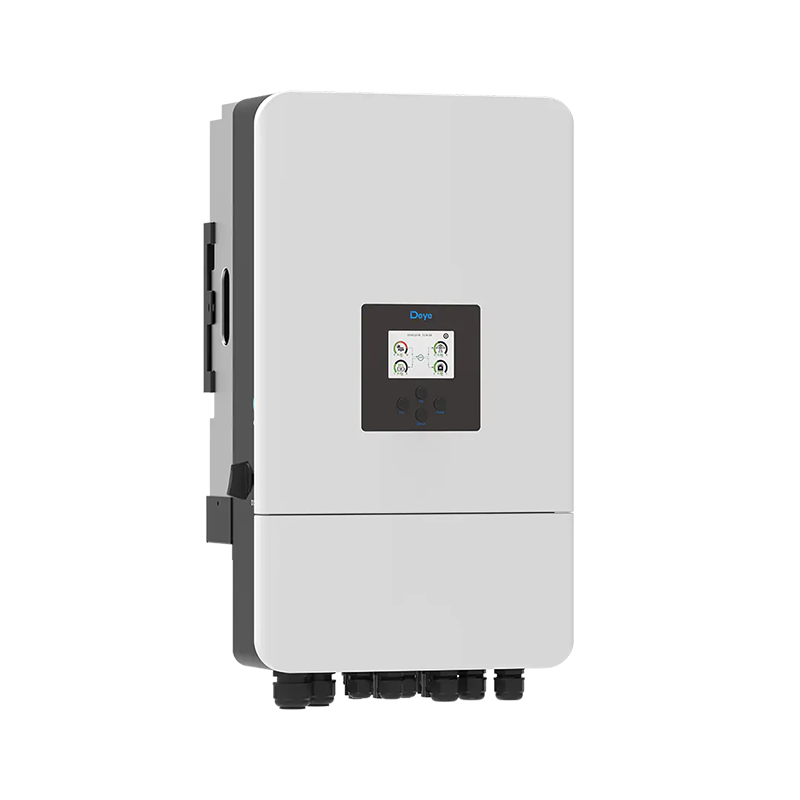 Deye 10 kW Three-Phase Low-Voltage Hybrid InverterA 10 kW three-phase low-voltage hybrid inverter for small commercial envelopes, combining battery integration, backup operation and scalable parallel design.View Product →
Where the envelope is large and the client wants a single point of control, an 80 kW to 125 kW three-phase string inverter paired with a separate energy management layer is often the cleaner architecture. Either way, insist on monitoring at string level — diagnosing a fault behind a facade panel without string data is an expensive afternoon.
BOS, Mounting and Cable Management
Balance-of-system work is where BIPV projects quietly succeed or fail. Standard rail systems rarely fit, because the mounting interface belongs to the facade or roof system supplier. Cables have to run inside the cavity without chafing against sharp edges, junction boxes need to remain reachable, and DC isolators have to be positioned where a technician can actually service them.
It helps to treat mounting systems, solar cable, connectors and combiner boxes as one coordinated package rather than four separate line items. Sizing cable for voltage drop across a tall facade run, and choosing connectors rated for the same environment as the modules, prevents the small irritations that turn into callbacks.
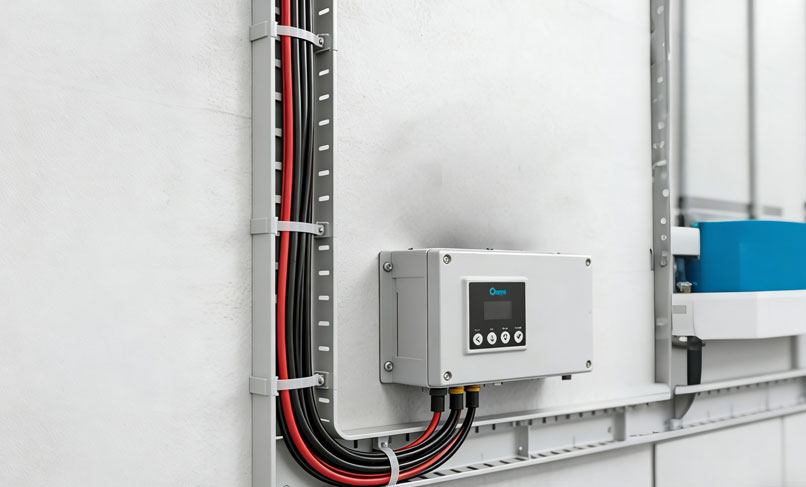 Photovoltaic Balance-of-System Components and AccessoriesA coordinated range of mounting systems, solar cables, combiner boxes and Deye smart accessories for safe, reliable photovoltaic system configuration.View Product →
Storage, Load Matching and the Grid Interface
BIPV output profiles are unusual. A west-facing facade peaks in the late afternoon, which is often exactly when a commercial building's load is still high and when export tariffs are least attractive. Coupling the envelope to a battery and a simple energy management strategy frequently improves the business case more than adding another ten square metres of cladding.
For industrial and commercial parks, a cabinet-based system in the 215 kWh class is a sensible starting point: it pairs with the existing distribution board, supports peak shaving and gives the site operator useful data. Larger sites can scale the same architecture across multiple cabinets.
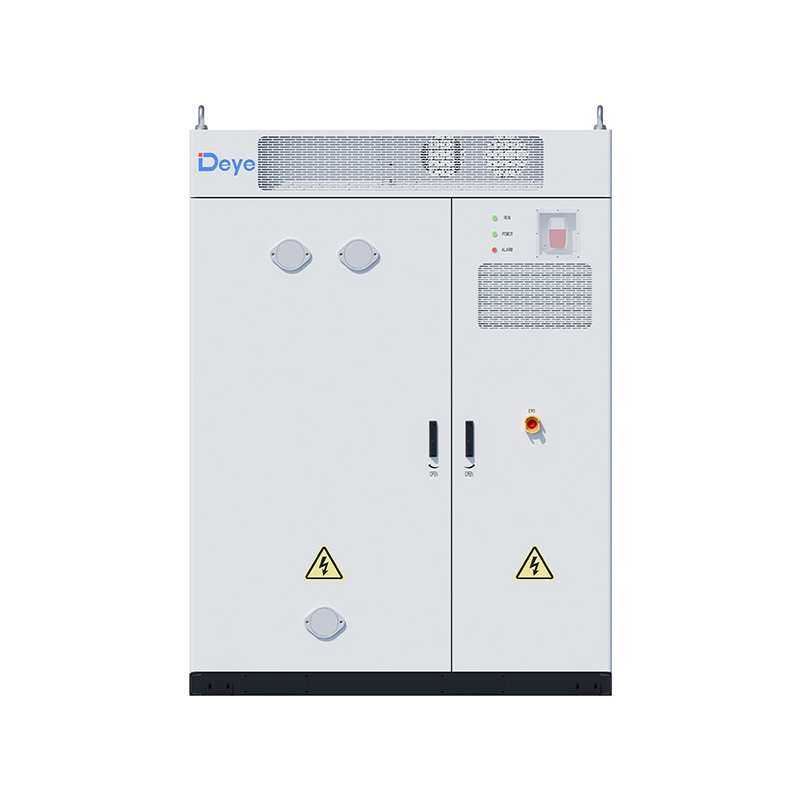 Deye 215 kWh All-in-One Solar and Battery CabinetAn outdoor cabinet-based PV and battery storage system for commercial and industrial sites, supporting peak shaving, backup and scalable off-grid parallel operation.View Product →
If the project sits in a park or a mixed-use development, it is worth reading our notes on industrial and commercial park solutions before fixing the system architecture.
A Practical Sourcing Checklist for Project Buyers
When you are procuring the electrical side of a BIPV project, the questions that save the most trouble later are surprisingly consistent:
- Does the datasheet give both electrical data and the relevant building certification for the integrated product?
- What is the fire classification, and does it match the compartment it will sit in?
- Who warrants what — the module performance, the weathertightness of the assembly, and the fixings?
- How many spare units are being delivered, and what is the lead time on a replacement?
- Is a mock-up panel or sample available for the facade contractor to trial before full production?
- Where will the goods ship from, and does that match the project programme?
For a deeper walkthrough of the procurement side, our team has written a practical BIPV guide for project buyers that goes into the specification and approval sequence in more detail.
Working Through a BIPV Project Without the Guesswork
Most of the difficulty in building integrated photovoltaics is not the module itself — it is coordination. Facade supplier, structural engineer, electrical contractor and buyer all hold a piece of the answer, and the electrical package is usually the last to be fixed. That is where a supplier with a broad catalogue and stock in more than one region genuinely helps: you can specify the inverter around the array you were given, match the battery to the load profile, and pull the mounting and cabling from the same place instead of chasing four lead times.
Our own experience comes from more than a decade of supplying PV and storage equipment into residential, commercial and industrial projects, with stock held for direct shipment from China and from regional warehouses in Europe and the United States. If you are sizing a facade array and want a second opinion on the inverter and battery pairing before the tender goes out, send over the elevations and the load data. We are always happy to talk through the numbers.






3+ Branch Offices
1+ Factory
Required fields are marked


Copyright @ Hangzhou Seetek New Energy Sci-tech Co., LtD. All rights reserved Solar Energy Storage Solution Solar Energy Storage Products Supplier
