


 Français
 2026.07.14
Seven Topologies Compared: Choosing the Right MS-GS215-2H3 Configuration
Content
- 1 Seven Wiring Diagrams, One Decision Framework
- 2 Pure On-Grid System — When You Don't Need Backup At All
- 3 PV-Storage On-Grid — Adding Direct Solar Input
- 4 PV-Storage Off-Grid — Islanded Operation Without a Grid Connection
- 5 On/Off-Grid with STS — Adding the 500kW Switch for Seamless Backup
- 6 PV-Storage On/Off-Grid with STS — Solar Plus Backup Together
- 7 PV-Storage-Diesel Hybrid (On/Off-Grid) — Adding a Third Power Source
- 8 PV-Storage-Diesel Hybrid (Off-Grid Only) — Full Islanding With Generator Backup
- 9 Choosing Between the Seven
Seven Wiring Diagrams, One Decision Framework
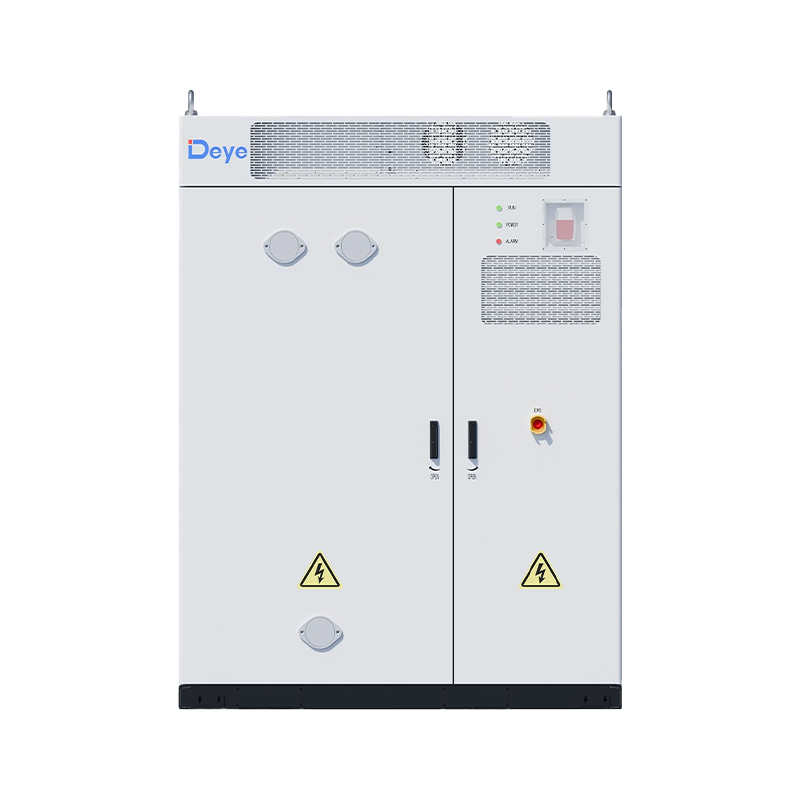
The same MS-G215/GS215 cabinet can be wired seven different ways, and the difference between them isn't cosmetic — it changes whether the project needs a static transfer switch, how many units can run in parallel, and whether a diesel generator has a defined interface at all. Picking the wrong topology early means re-engineering the electrical room later.
The seven configurations split along three questions: does the project need direct PV input, does it need to keep running when the grid drops, and does it need a diesel generator as a third power source. Answering those three questions in order gets you to the right topology faster than comparing all seven side by side.
Pure On-Grid System — When You Don't Need Backup At All
This is the simplest configuration: storage-only MS-G215-2H3 units tied directly to the grid through Ethernet-connected EMS control, with no PV input and no islanding capability. It supports up to 20 units in parallel, making it the highest-scale topology in the lineup precisely because it doesn't carry the complexity of backup switching.
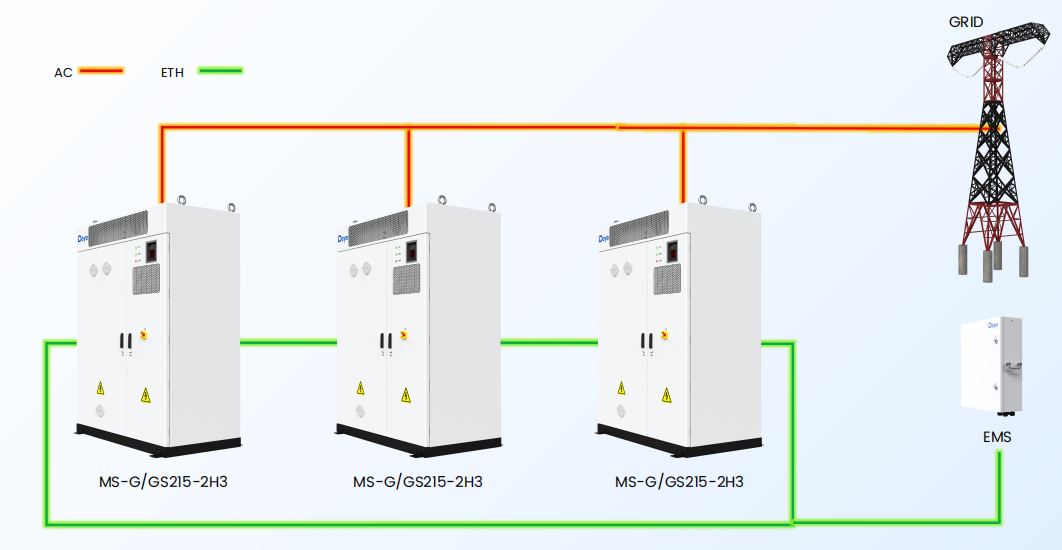
One EMS unit covers up to 16 local controllers, so a 20-unit array needs at most two EMS units. This topology fits arbitrage and demand-charge-reduction use cases where continuity through a grid outage isn't a requirement — the project is optimizing electricity cost, not resilience.
PV-Storage On-Grid — Adding Direct Solar Input
Swap the storage-only cabinet for the GS variant and this topology adds a built-in 200kW MPPT stage per unit, letting PV connect directly into the cabinet rather than through a separate inverter. Scale stays identical to the pure on-grid case — up to 20 units in parallel — because the added PV path doesn't change the grid-side parallel limit.
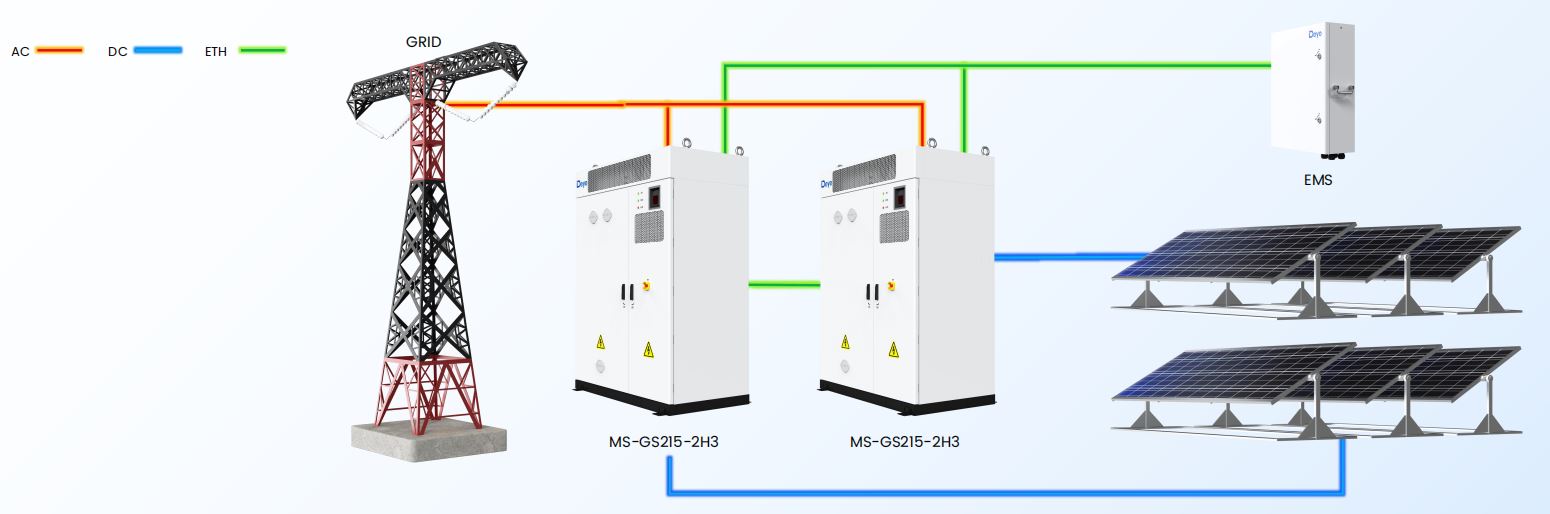
This is the default choice for a rooftop-plus-storage project that will always have a grid connection available. It's a smaller step up from pure on-grid than it looks — the same EMS-to-16-LC ratio applies, and the only real addition is the DC PV wiring into each cabinet.
PV-Storage Off-Grid — Islanded Operation Without a Grid Connection
Drop the grid connection entirely and this topology serves load directly from PV and battery storage. The parallel limit drops to 10 units in this configuration — half of the on-grid maximum — because off-grid parallel operation without a static transfer switch requires tighter synchronization between units than grid-following operation does.
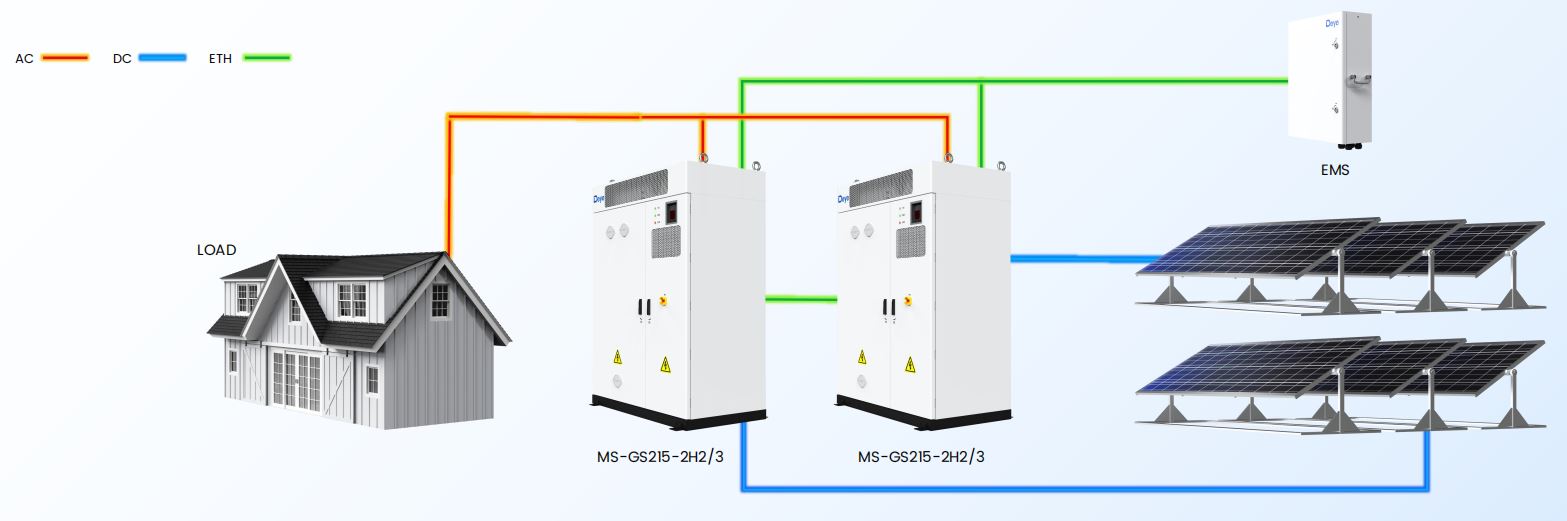
A single EMS still covers up to 16 LCs at this scale, so the EMS count rarely becomes the limiting factor — the 10-unit cap is what determines maximum project size here, not the control layer.
On/Off-Grid with STS — Adding the 500kW Switch for Seamless Backup
This is where the MS-TS500-2 static transfer switch enters the picture. Storage-only MS-G215-2H3 units connect through the STS, which sits between grid, load, and the cabinets, handling the transition between grid-connected and islanded operation without the load noticing. The tradeoff for that seamless switching is scale: this topology caps out at 5 units in parallel, a fraction of the 20-unit pure on-grid limit.
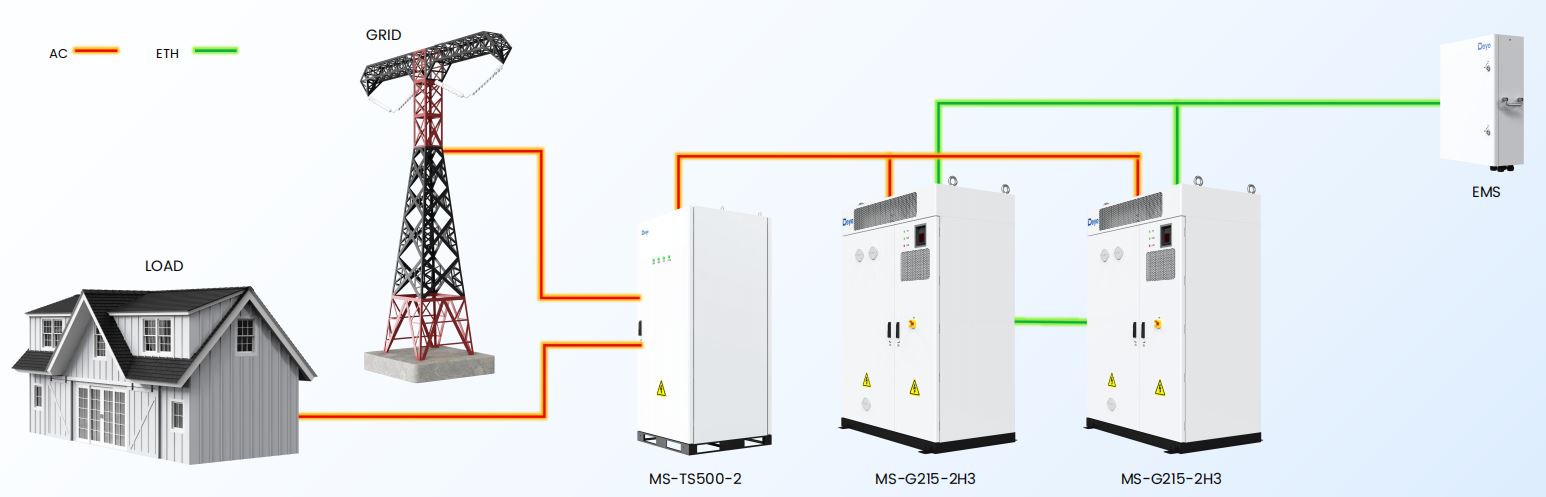
That lower ceiling is a direct consequence of the STS's own 500kW rating — five 100kW cabinets is the practical match for a single switch. Projects needing more backup capacity than that need to size around multiple STS units rather than pushing past this topology's limit.
PV-Storage On/Off-Grid with STS — Solar Plus Backup Together
Functionally this is the PV-enabled counterpart to the previous topology: GS-variant cabinets with built-in MPPT, still routed through an MS-TS500-2 for grid/off-grid switching. The parallel limit stays at 5 units, matching the STS's 500kW ceiling regardless of whether PV is present.
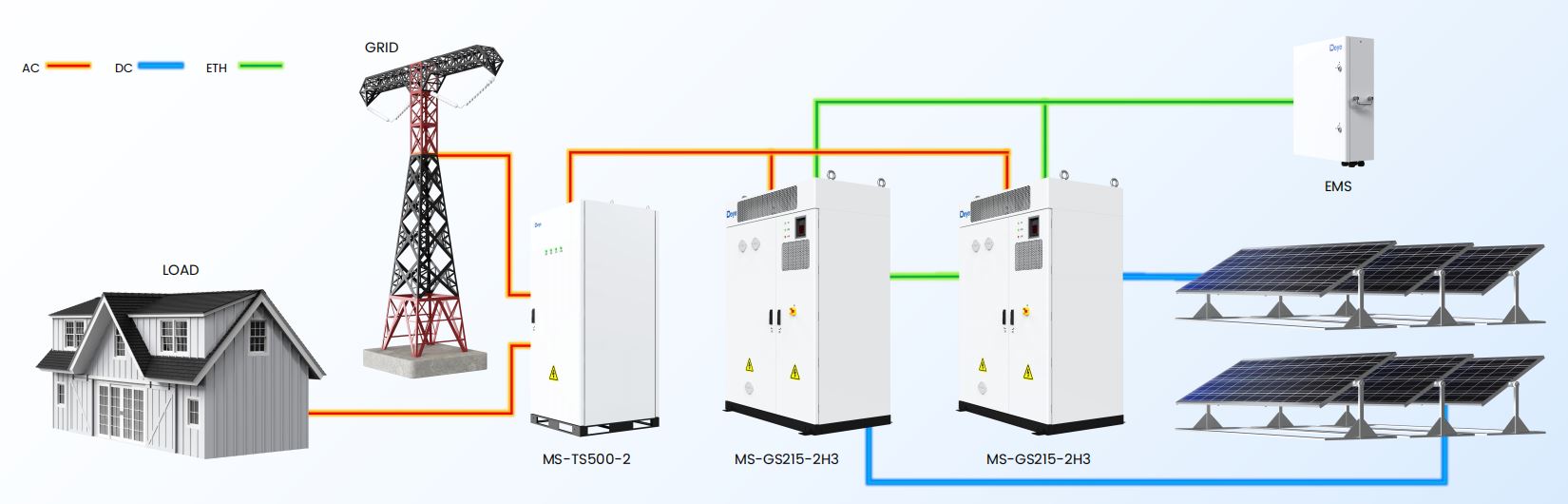
This configuration is the one to reach for when a project wants both onsite solar generation and guaranteed continuity through grid outages — the two most commonly requested features that, individually, sit in separate topologies above.
PV-Storage-Diesel Hybrid (On/Off-Grid) — Adding a Third Power Source
The MS-TS500-2 is explicitly built to be compatible with power grid, loads, and diesel generators simultaneously, and this topology puts that to use: the same PV-storage-plus-STS structure as above, with a diesel generator wired in as a third source the STS can switch between. Parallel scale holds at 5 units, since the limit is still set by the STS rather than by adding the generator.
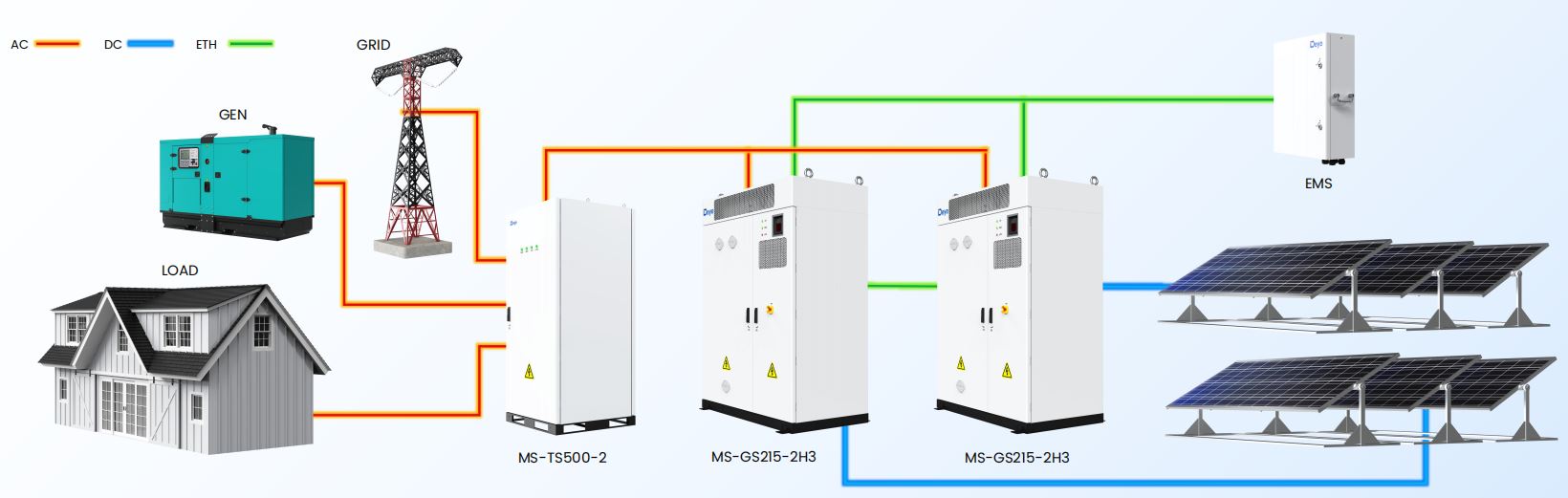
Sites that lose grid power for extended periods — not just the seconds an STS bridges on battery alone — need this third leg. The generator becomes the fallback once battery state of charge runs down during a prolonged outage, with the grid still available as the primary source when present.
PV-Storage-Diesel Hybrid (Off-Grid Only) — Full Islanding With Generator Backup
The final topology removes the grid connection entirely, leaving PV, storage, and diesel generator as the only power sources. The remarks on this configuration are explicit that the MS-TS500-2 is required here specifically because a diesel generator is included — without a generator, the plain PV-storage off-grid topology above would suffice with a lower parts count.
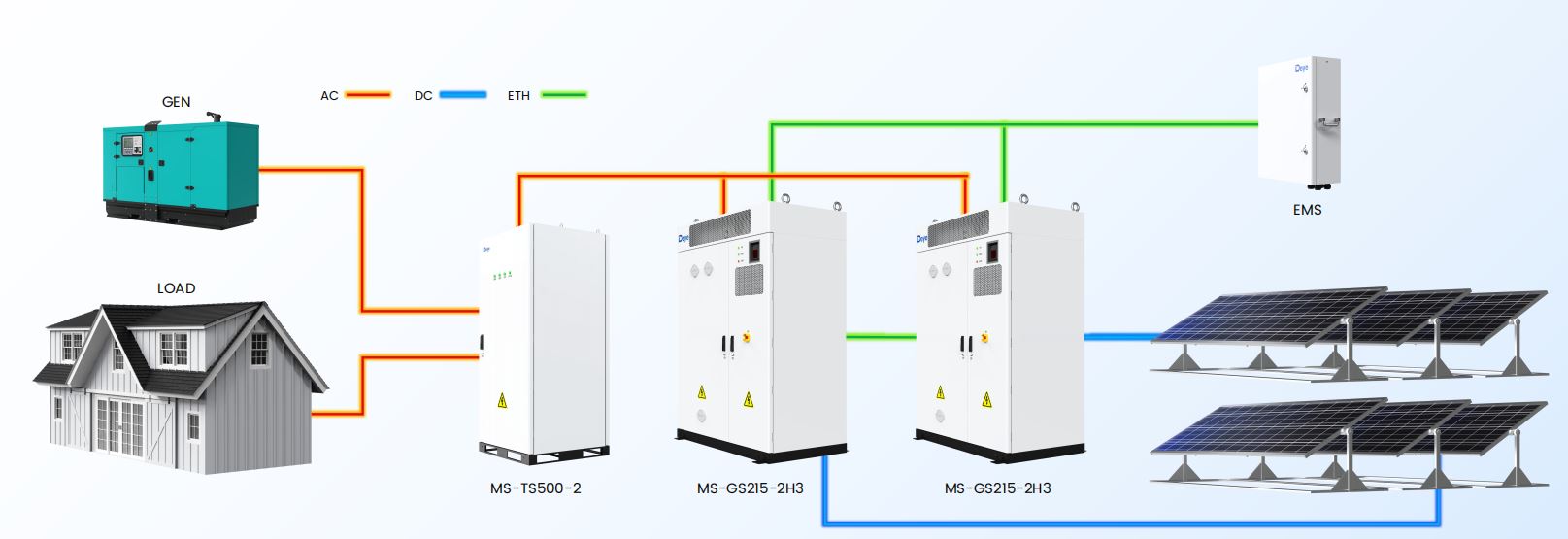
This is the configuration for genuinely remote sites — mine sites, island microgrids, construction camps — where a grid connection was never an option and diesel is the only available fallback once solar and battery can't cover load alone.
Choosing Between the Seven
Three questions narrow the seven options down fast: whether PV is present, whether the grid connection is permanent or needs to be bridged during outages, and whether a diesel generator is part of the design. The STS is the real dividing line — its presence caps parallel scale at 5 units but adds seamless switching and generator compatibility that the STS-free topologies don't have.
| Topology | PV Input | STS Required | Diesel Generator | Max. Units |
|---|---|---|---|---|
| Pure On-Grid | No | No | No | 20 |
| PV-Storage On-Grid | Yes | No | No | 20 |
| PV-Storage Off-Grid | Yes | No | No | 10 |
| On/Off-Grid with STS | No | Yes | No | 5 |
| PV-Storage On/Off-Grid with STS | Yes | Yes | No | 5 |
| PV-Storage-Diesel (On/Off-Grid) | Yes | Yes | Yes | 5 |
| PV-Storage-Diesel (Off-Grid) | Yes | Yes | Yes | 5 |
For most industrial park and commercial rooftop projects, the choice comes down to two candidates: the PV-storage on-grid configuration of the MS-GS215-2H3 for pure cost optimization at scale, or the STS-based backup topology when outage continuity is a hard requirement. Sites weighing which fits their load profile can start from the industrial and commercial parks peak-shaving solution and work backward to the topology that supports it.



3+ Branch Offices
1+ Factory
Required fields are marked


Copyright @ Hangzhou Seetek New Energy Sci-tech Co., LtD. All rights reserved Solar Energy Storage Solution Solar Energy Storage Products Supplier
