


 Français
 2026.07.14
Six Layers of Defense: Deye's Aerosol Fire Suppression and Explosion Venting
Content
- 1 Why a Battery Cabinet Needs Six Independent Safety Layers, Not One
- 2 Layer 1 — Early Warning: Temperature and Smoke Detection
- 3 Layer 2 — Gas Detection and Forced Exhaust: Racing 167 L/min Against 3,500 L/min
- 4 Layer 3 — Physical Containment: Pack-Level Thermal Insulation
- 5 Layer 4 — Automatic Suppression: Aerosol Agent and the Shutdown Sequence
- 6 Layer 5 — Backup Extinguishing: The Automatic Sprinkler System
- 7 Layer 6 — Pressure Management: Explosion Venting Design
- 8 How the Six Layers Interlock — and What the Certifications Confirm
Why a Battery Cabinet Needs Six Independent Safety Layers, Not One
A 215kWh LFP cluster packed into a single cabinet carries enough stored energy that no single safety mechanism can be trusted to catch every failure mode on its own. Deye's approach in the MS-GS215-2H3 splits the problem into six functionally independent layers — detection, gas exhaust, physical containment, chemical suppression, water backup, and pressure relief — each designed to catch what the layer before it might miss.
None of these six layers is unique to Deye. What matters here is how they're sequenced and interlocked inside one cabinet, and where the actual thresholds and response numbers sit. That's what this breakdown covers, section by section, cross-referenced to the exact pages in Deye's technical documentation.
Layer 1 — Early Warning: Temperature and Smoke Detection
The first layer doesn't suppress anything — it just needs to be fast and unambiguous. Temperature sensors, built as thermistors, trip an alarm once a preset threshold is crossed. A separate photoelectric smoke detector watches for light scatter caused by smoke particles, triggering independently of the temperature channel.
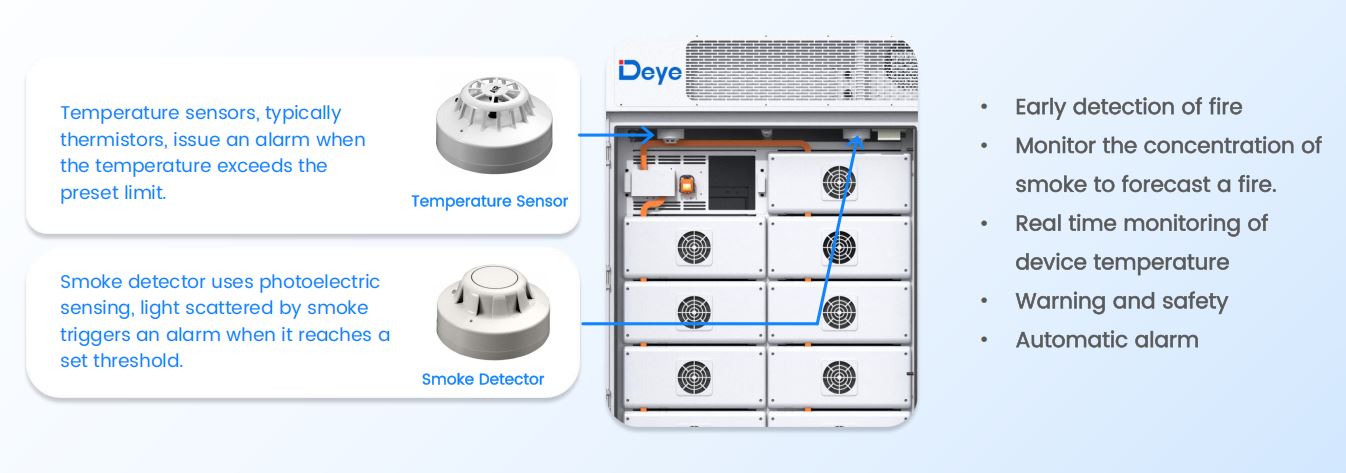
Running two separate sensing principles in parallel, rather than one composite sensor, means a slow thermal drift and a sudden smoke event get caught by different mechanisms — a single point of failure in one channel doesn't blind the other.
Layer 2 — Gas Detection and Forced Exhaust: Racing 167 L/min Against 3,500 L/min
LFP cells under stress vent combustible gas before they ever reach open flame. Deye's documentation gives a specific number for this cabinet: the MS-G215 battery compartment can produce up to 167 liters of combustible gas per minute under worst-case conditions. The exhaust fan is sized well past that figure, rated to move 3,500 liters per minute — roughly a 20x margin.
| Parameter | Value |
|---|---|
| Combustible gas generation (worst case) | 167 L/min |
| Exhaust fan capacity | 3,500 L/min |
| Trigger action | Alarm → fire linkage ventilation → EMS notification → air inlet/outlet and fan activation |
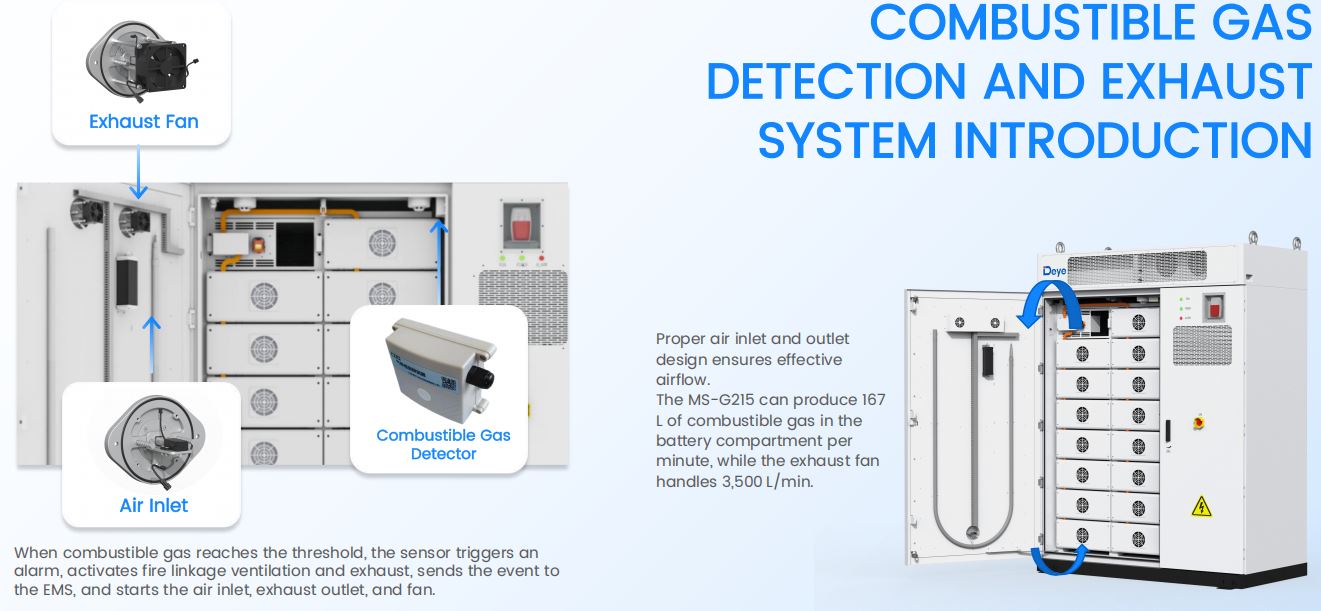
The margin matters because gas detection alone doesn't remove the hazard — it buys time. Once the sensor crosses threshold, the system doesn't just sound an alarm; it actively opens inlet and outlet paths and starts the fan, and reports the event to the EMS so the rest of the cabinet's control logic knows a gas event is in progress.
Layer 3 — Physical Containment: Pack-Level Thermal Insulation
If the first two layers don't stop an escalating cell, the next line of defense isn't active at all — it's material. Each pack is wrapped in low-thermal-conductivity insulation specifically to slow heat transfer to neighboring packs, reducing the chance that one pack's failure propagates into a cluster-wide event.
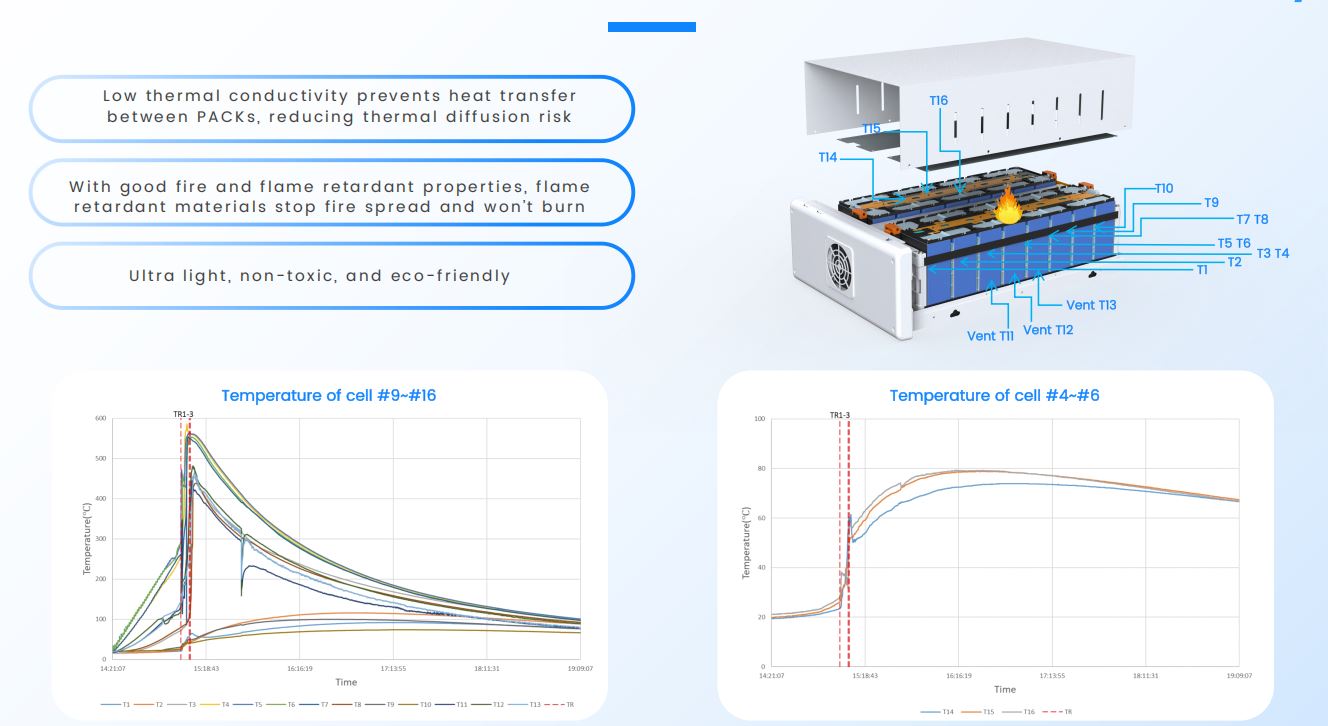
The insulation material is also specified as flame-retardant — it resists ignition rather than fueling it — and described as lightweight and non-toxic, which matters for what gets released if it does eventually decompose under sustained heat. This layer buys the detection and suppression layers additional time by physically slowing propagation between packs.
Layer 4 — Automatic Suppression: Aerosol Agent and the Shutdown Sequence
When thermal, smoke, or gas sensors confirm an event — or the aerosol canister's own fuse is punctured directly — the cabinet's firefighting medium activates. Deye specifies aerosol or perfluorohexane (C6F14) as the extinguishing agent, triggered either by fuse ignition or electric ignition.
| Step | Action |
|---|---|
| 1 | PCS shutdown; air conditioning turned off |
| 2 | Running light off, fault light on, sound and light alarm activated |
| 3 | PACK fan switches to full speed |
| 4 | AC and DC sides disconnected |
| 5 | Remote emergency stop status output sent |
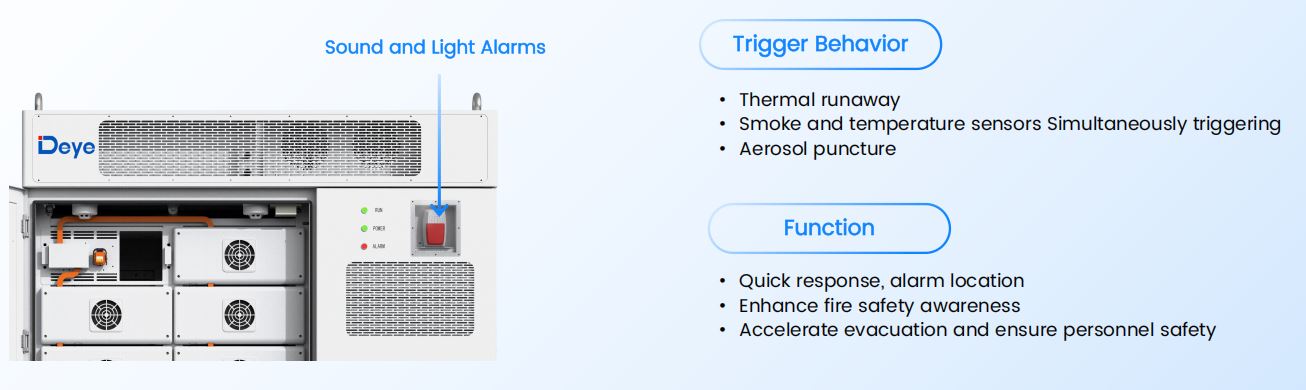
This is the point where the six layers stop acting independently. Suppression doesn't just release an agent — it forces a coordinated electrical shutdown, cutting power to the cells and disconnecting both AC and DC sides so the fire isn't being continuously fed by an energized system while it's being extinguished.
Layer 5 — Backup Extinguishing: The Automatic Sprinkler System
Aerosol suppression is the primary response, but Deye's design includes a water-based backup. A thermosensitive glass tube in the sprinkler head breaks once flame or smoke pushes local temperature to 79°C, releasing water directly onto the source. The system supports both closed sprinklers, which activate individually at that threshold, and open sprinklers that discharge once the cabinet's pipeline control valve is opened — the choice between the two is configurable to the deployment.
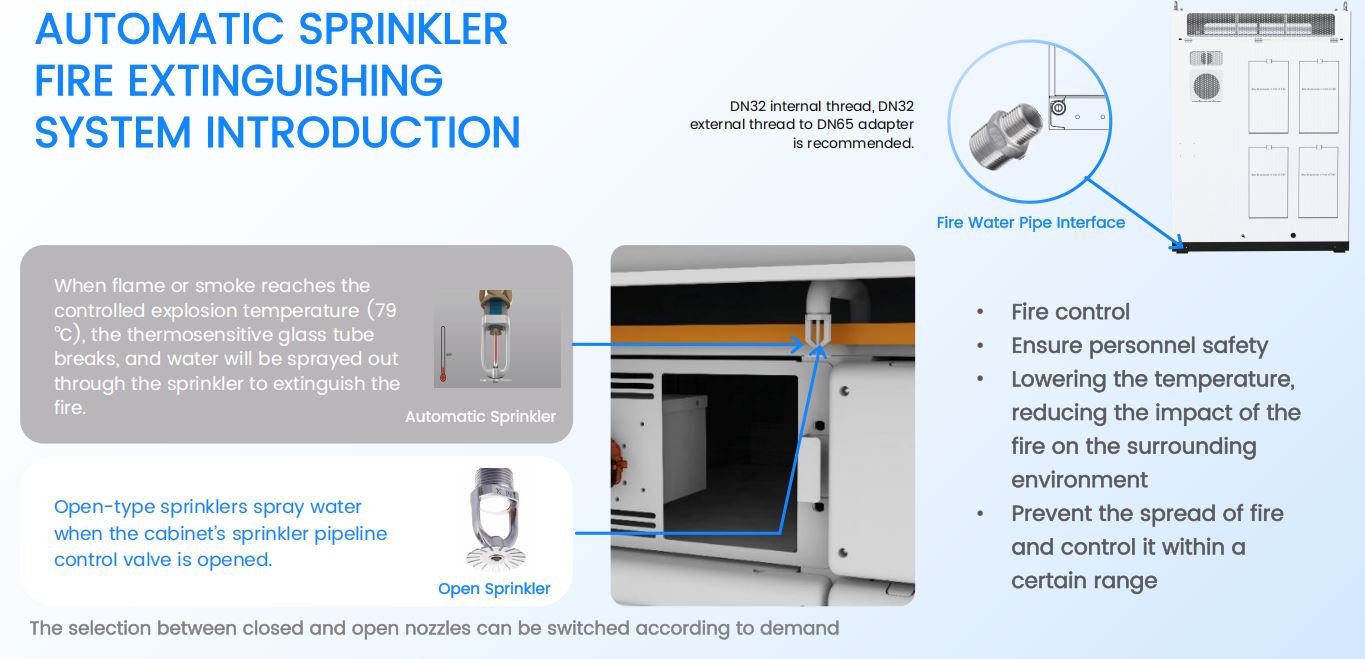
Having a second extinguishing mechanism on a completely different physical principle — water rather than chemical agent — means a failure or depletion of the aerosol system doesn't leave the cabinet with no active suppression at all.
Layer 6 — Pressure Management: Explosion Venting Design
The last layer isn't about stopping fire — it's about controlling what happens if pressure builds anyway. Explosion vents positioned around the manual service disconnect (MSD) are designed to balance pressure between the front and rear of the battery compartment. In an explosion event, the shock wave is directed toward the rear plate, which is engineered to open smoothly rather than blow outward toward the cabinet's front door and adjacent equipment.
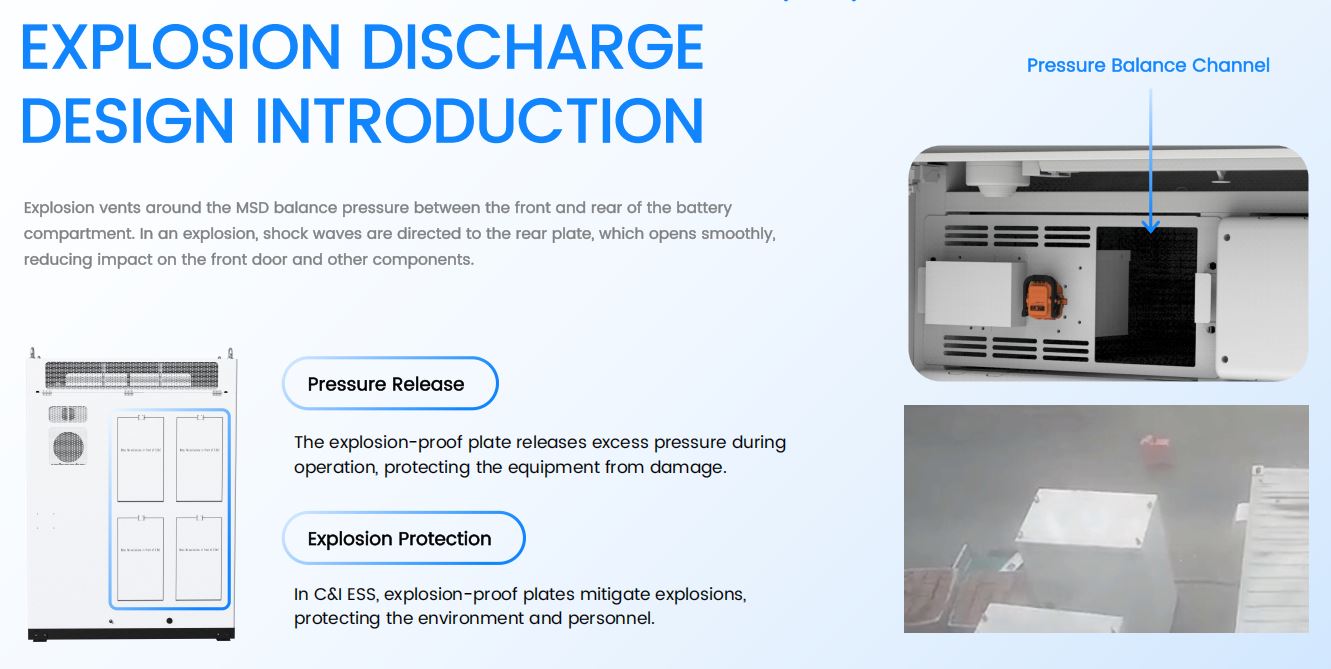
This is a purely structural safeguard: the explosion-proof plate releases excess pressure during operation to protect the equipment, and in a worst-case event, it mitigates the blast to protect both personnel and surrounding infrastructure rather than preventing the pressure event itself.
How the Six Layers Interlock — and What the Certifications Confirm
None of these six layers is described in Deye's materials as a standalone selling point — they're listed together under a single "Comprehensive Safety" feature set that also includes the cabinet's IP54 and C5 anti-corrosion ratings, -20°C to 50°C operating range, and system-level certification to UN3536, IEC61000, IEC62477, and IEC60730. Those certifications aren't decorative; they're what independently verifies the transport safety, EMC behavior, power electronics safety, and automatic electrical control claims that the six layers above depend on to actually function as specified.
| Layer | Mechanism | Role |
|---|---|---|
| 1 | Temperature + smoke detection | Early warning |
| 2 | Combustible gas detection + exhaust | Hazard dilution |
| 3 | Pack-level thermal insulation | Propagation containment |
| 4 | Aerosol/perfluorohexane suppression | Active extinguishing + shutdown |
| 5 | Automatic sprinkler (79°C trigger) | Backup extinguishing |
| 6 | Explosion venting around MSD | Pressure and blast management |
For an integrator evaluating this against other cabinet-level systems, the practical question isn't whether a competing product has a fire suppression feature — most do. It's whether that feature is one layer or six, and whether those layers are electrically interlocked with the EMS and PCS shutdown sequence, or bolted on as an isolated subsystem. Full documentation on how this safety architecture is packaged into the complete cabinet is available on the MS-GS215-2H3 C&I energy storage system product page, alongside the rest of Seetek's commercial and industrial battery energy storage system lineup.




3+ Branch Offices
1+ Factory
Required fields are marked


Copyright @ Hangzhou Seetek New Energy Sci-tech Co., LtD. All rights reserved Solar Energy Storage Solution Solar Energy Storage Products Supplier
