


 Français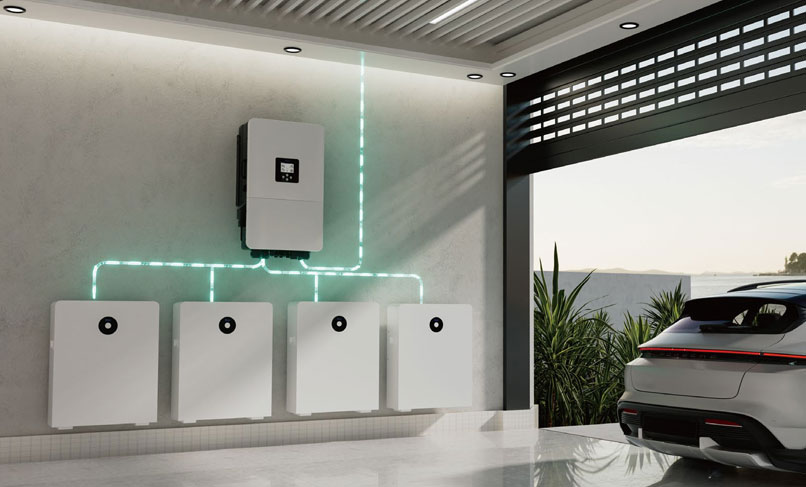

Industry Knowledge
From Telecom Towers to Remote Farms: Where Off-Grid Power Makes Sense
Not every site has the luxury of a stable grid connection. Telecom towers in remote regions, agricultural operations far from the nearest substation, island properties, construction sites, and disaster-relief camps all share the same challenge: they need reliable power with no utility line to fall back on.
This is exactly the gap off-grid inverters are built to fill. Drawing on solar input and battery storage, they keep critical loads running continuously — lighting, communications equipment, water pumps, refrigeration — regardless of what's happening (or not happening) on the grid nearby.
With models spanning from 2kW up to 15kW, this range covers everything from a small remote cabin or monitoring station to a larger farm building or off-grid workshop with multiple appliances running at once.
Powering Sensitive Equipment: What to Look for in an Off-Grid Inverter
When there's no grid to smooth things out, the quality of the power coming from your inverter becomes the whole story. A pure sine wave output — clean, stable, and free of the distortion you'd get from a cheaper modified-wave unit — is essential for sensitive electronics, medical equipment, and anything with a motor or compressor.
Surge capacity matters just as much. Water pumps, refrigeration compressors and power tools all draw a brief spike of current well above their running wattage the moment they switch on. An inverter that can't handle that spike will trip or shut down, even if its continuous rating looks sufficient on paper.
When evaluating an off-grid inverter, look past the headline kW rating and check both the waveform quality and the surge or peak power figure — together, these determine whether your equipment will actually run smoothly day to day.
Solar, Battery and Generator: How Off-Grid Systems Balance Multiple Power Sources
An off-grid system rarely relies on just one source of power. Solar panels handle the bulk of daytime generation, batteries store that energy for use after dark or during cloudy stretches, and a generator often sits in reserve for extended low-sun periods or higher-than-expected demand.
The inverter's job is to coordinate all three. It prioritizes solar when it's available, draws from the battery as the next step, and brings the generator online — and back offline — automatically based on battery state and load conditions. Many of our off-grid models support configurable work modes, so the priority order can be tuned to match how a site actually operates.
Getting this balance right is less about any single component and more about how well they're sized relative to each other — enough solar to cover typical days, enough battery to bridge the gaps, and a generator sized for the exceptions rather than the everyday.
Single-Phase or Three-Phase: Matching Your Off-Grid Setup to Site Requirements
The choice between single-phase and three-phase isn't about which is "better" — it's about what your site's loads actually need. Single-phase units, like our SUN-2K to SUN-8K G04/G02 models, cover most residential and small-site loads: lighting, appliances, electronics and smaller pumps.
Three-phase units, such as our SUN-5K to SUN-15K G06P3 models, come into play once a site has larger motors, three-phase pumps, or equipment commonly found on farms and in light-industrial settings. Three-phase power also distributes load more evenly across wiring, which matters as total demand increases.
If you're not sure which setup your site needs, the simplest starting point is to list out the equipment that will run simultaneously and check its phase requirements — that alone usually points clearly toward single-phase or three-phase.