


 Français
 2026.09.13
Are LiFePO4 Batteries Safe? LFP Chemistry, Thermal Runaway & BMS Explained
Content
Ask a room full of installers whether LiFePO4 batteries are safe, and you will get ten versions of the same answer: yes, LFP is the safest lithium chemistry you can realistically mount on a wall inside a home or a business today. That is a fair starting point, and it is usually where the conversation stops.
It should not stop there. Safety is not a single property that a cell either has or lacks. It is the result of a stable cathode chemistry, a battery management system that never stops paying attention, a production line that actually follows its own procedures, and an installation that respects clearances, torque values and cable sizing. Remove any one of those layers and the chemistry alone will not carry the project.
We have supplied lithium storage into residential, commercial and industrial projects for more than a decade, and the pattern is remarkably consistent. The incidents people worry about almost never trace back to the phosphate chemistry itself. They trace back to something else in the chain. So let us walk through what genuinely makes LFP safe, where its real limits sit, and what you should verify before you sign a purchase order.
Why the Chemistry Is the First Safety Layer
LiFePO4 stands for lithium iron phosphate. Inside the cell, the cathode is built on an olivine crystal lattice, and the phosphate groups inside that lattice hold their oxygen atoms with strong covalent bonds. Those bonds are the reason the material stays intact under abuse.
Compare that with layered-oxide chemistries such as NMC or LCO, where oxygen is bound far more loosely. When a layered-oxide cell is overheated, the lattice can break down and release oxygen. Oxygen released inside a sealed cell is exactly what a fire needs to sustain itself, which is why those chemistries can produce a self-feeding reaction that is genuinely difficult to extinguish.
LFP behaves differently. Heat it hard enough and it will still degrade, vent and produce smoke, but it does not readily supply its own oxygen and it takes considerably more energy to push it into a runaway state. That structural difference is the entire basis behind the phrase "LFP does not easily go into thermal runaway." It does not mean nothing can ever happen. It means the margin is much wider.
| Safety factor | LiFePO4 (LFP) | Layered-oxide lithium (NMC, LCO) |
|---|---|---|
| Cathode structure | Olivine lattice with strong P-O covalent bonds | Layered oxide with loosely bound oxygen |
| Oxygen release when heated | Minimal | Yes, and it can feed the reaction |
| Typical thermal runaway onset | Roughly 250°C and above | Roughly 150°C to 210°C |
| Outcome in crush, nail or overcharge tests | Venting and smoke far more likely than sustained flame | Fire or rupture is a realistic outcome |
| Electrolyte | Still organic and flammable, but rarely ignited | Flammable, often the main fuel source |
| Typical cycle life | 4,000 to 6,000 cycles and beyond | 1,000 to 2,000 cycles |
If you want to go one level deeper into how chemistry translates into system value over a project's lifetime, we covered the wider benefits of energy storage battery technology in an earlier article.
Thermal Runaway, Explained Without the Drama
Thermal runaway is a chain reaction, not a single event. It starts when heat is generated inside a cell faster than the cell can shed it. That heat accelerates the internal chemistry, which generates more heat, and the loop keeps tightening until the cell vents. Every lithium chemistry can theoretically enter that loop. The question is how much abuse it takes to get there and how violent the exit is.
For LFP, the trigger temperature is high enough that most real-world faults never reach it. A short circuit will blow a fuse or trip a breaker long before a cell reaches 250°C. An overcharge is caught by the BMS and disconnected. A hot garage on a summer afternoon is nowhere close to the threshold.
What Actually Causes Failures in the Field
When storage systems do fail, the causes we see documented and discussed most often are depressingly ordinary:
- Cells sourced from unverified supply chains, with no traceable manufacturing records or test reports.
- A BMS that is undersized for the pack, mismatched to the inverter, or running outdated firmware.
- Loose busbar or terminal connections that create resistance, heat and eventually arcing.
- Water ingress through unsealed conduit entries or poorly rated enclosures.
- Improper cable sizing on the DC side, leading to sustained overcurrent.
- Stacking batteries without respecting the manufacturer's clearance and ventilation requirements.
None of those are chemistry problems. All of them are solvable with better procurement and better workmanship.
The BMS Is Half of the Safety Story
A modern LFP pack is only as safe as the electronics supervising it. The battery management system is continuously monitoring every cell group and acting on what it finds. In a well-designed pack it handles:
- Cell-level voltage monitoring, with over-voltage and under-voltage cut-offs.
- Active or passive balancing to keep cells within a narrow band.
- Charge and discharge current limits, including short-circuit protection.
- Temperature sensing at multiple points, with charge and discharge derating when things get warm.
- Contactor or relay control that physically isolates the pack when a fault is detected.
- State of charge and state of health reporting, so degradation is visible rather than invisible.
This matters because the cells and the electronics have to be designed together. A premium LFP cell paired with a generic BMS is not a safe battery; it is a safety claim without the supporting evidence. That is why we keep our storage recommendations inside a single, well-documented ecosystem rather than mixing whatever happens to be cheapest that month.
Certification: The Paperwork Behind the Promise
Marketing language is flexible. Test reports are not. When you are evaluating any LFP product for a real project, ask for the documentation rather than the brochure. The standards that come up most frequently in residential and commercial storage are:
- IEC 62619, covering safety requirements for industrial and stationary lithium cells and batteries.
- UL 1973, the North American standard for stationary battery systems.
- UL 9540 and UL 9540A, addressing system-level safety and fire propagation behaviour.
- IEC 63056, covering secondary cells used in electrical energy storage systems.
- UN 38.3, which governs safe transport of lithium cells and packs by air, sea and road.
- CE and UKCA marking for European and UK market access, with the accompanying declarations of conformity.
A supplier who can produce these documents quickly, along with user manuals in the languages of the market you are installing in, is usually a supplier who understands that safety is a chain of evidence.
What This Looks Like in Real Installations
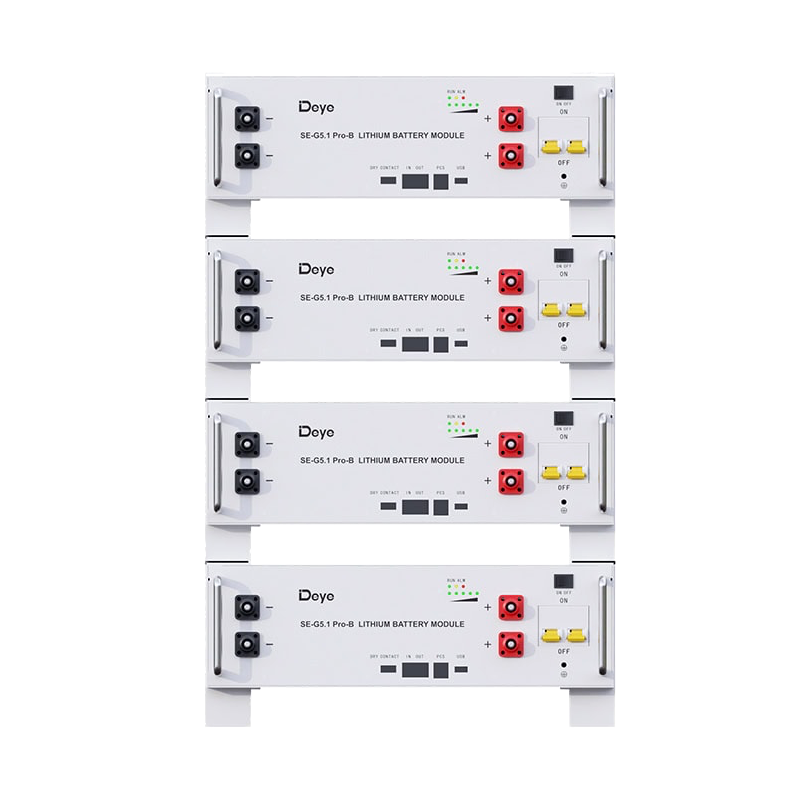
In a residential project, the most common configuration is a hybrid inverter paired with a low-voltage LFP pack mounted on a garage or utility wall. That combination puts the battery inside the living envelope, so the pack has to be genuinely well behaved: sealed enclosure, integrated BMS, and a cabinet that does not rely on the homeowner to think about it. A representative example is the Deye SE-G5.1 Pro-B low-voltage LFP battery, a 5.1 kWh wall-mounted module that can be stacked for larger capacity.
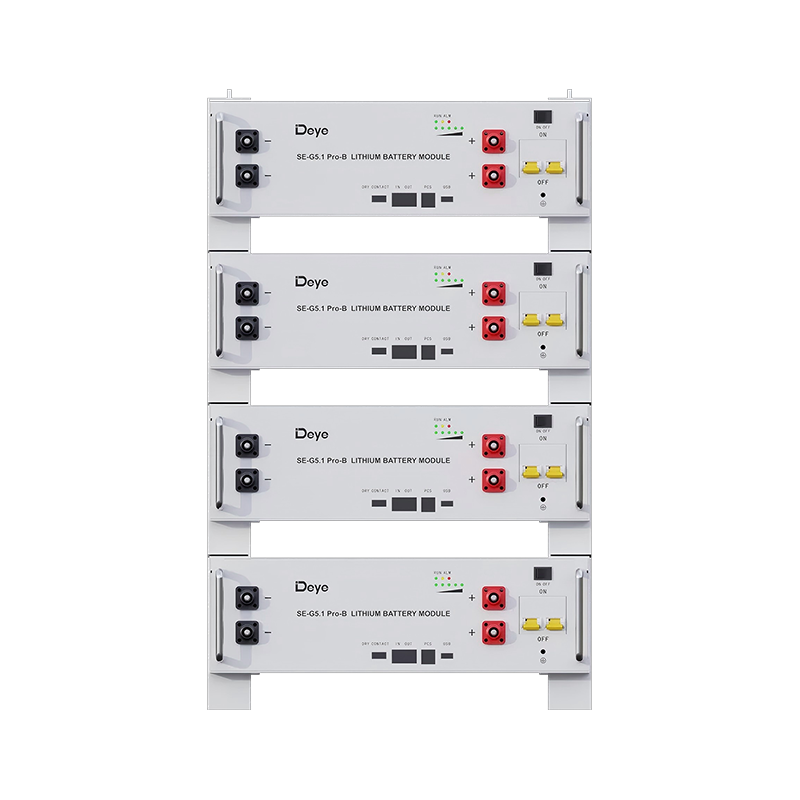 Deye SE-G5.1 Pro B LV batteryThe SE-G5.1 Pro B LV Battery is a compact and versatile lithium energy storage module designed for flexible integration into residential solar systems and small-scale ...View Product →
For homes and small commercial sites that need more energy in a smaller footprint, high-voltage systems are the usual answer. Higher string voltage means lower current for the same power, thinner cables, lower losses and a more compact installation. The Deye BOS-G high-voltage battery system is built around stackable modules with a shared BMS, which keeps balancing and fault handling in one place rather than spread across separate units. The full technical detail is set out in the BOS-G series brochure.
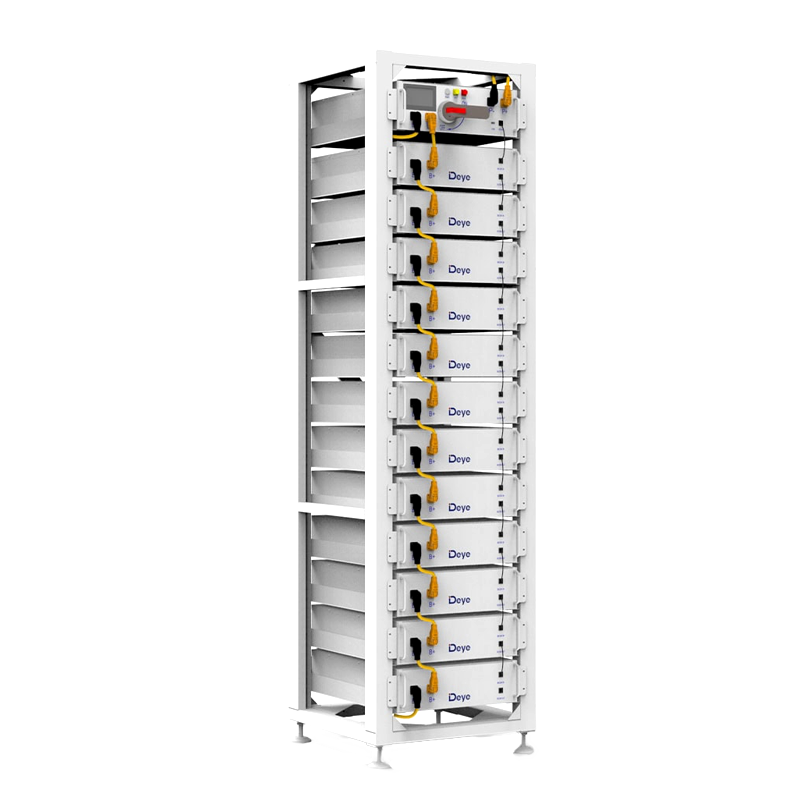 Deye BOS-G High Voltage Battery SystemA modular high‑voltage LFP battery platform aimed at small‑scale commercial and industrial storage deployments where scalability and system voltage matter. BOS‑G is de...View Product →
Once you move into commercial and industrial territory, safety becomes a question of architecture as much as cells. An all-in-one cabinet with integrated fire detection, thermal management, ventilation and a site-level controller is a very different proposition from a room full of racked modules. The Deye MS-GS215-2H3 C&I energy storage system packages a 215 kWh LFP battery, power conversion and safety systems into a single outdoor-rated unit, which simplifies both the permitting conversation and the commissioning work.
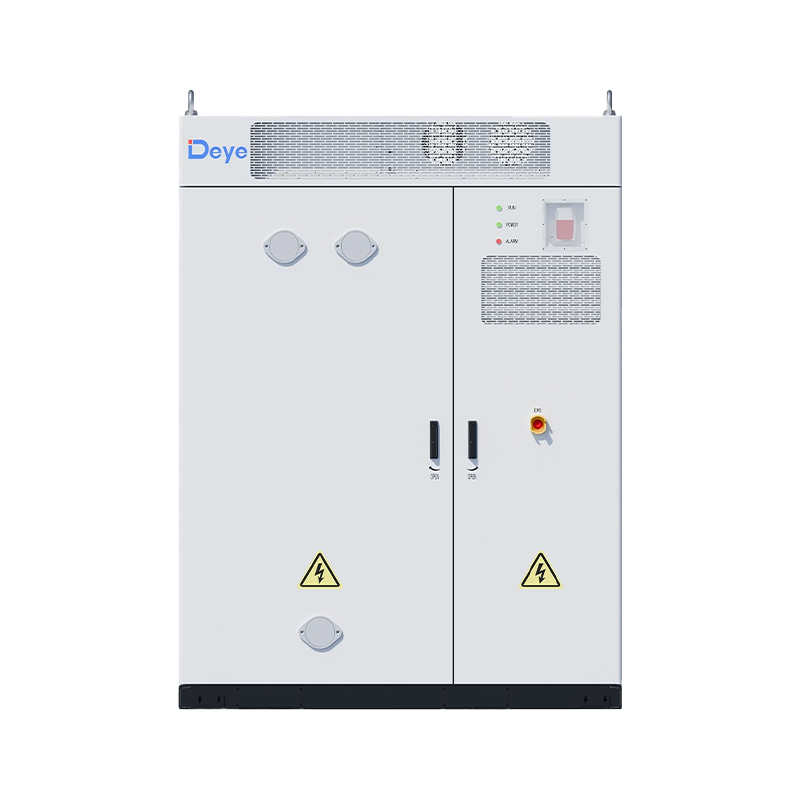 Deye MS-G215-2H3 C&I Energy Storage SystemThe Deye MS-G215-2H3 is a commercial and industrial battery energy storage cabinet created for users who need a dedicated 100kW / 215kWh BESS for peak demand managemen...View Product →
Across all three tiers, the same principle holds: LFP is chosen for these applications precisely because it gives designers a comfortable safety margin around a chemistry that would otherwise require far more aggressive protection measures.
Questions We Hear Most
Are LiFePO4 batteries completely fireproof?
No, and any supplier who tells you otherwise is overselling. LFP is significantly more resistant to fire than NMC or LCO, but it is not fireproof. It can still vent, produce smoke and, in extreme abuse scenarios, ignite. The honest claim is a much lower risk, not zero risk.
Can LFP batteries be installed indoors?
Yes, and this is one of the main reasons they dominate home storage. Their thermal stability makes indoor installation practical in garages, utility rooms and basements, provided you follow the manufacturer's clearance, ventilation and mounting requirements and comply with local fire codes.
Does the BMS make other lithium chemistries just as safe?
It helps, but it cannot rewrite thermodynamics. A good BMS dramatically reduces the likelihood of an NMC cell being pushed into runaway, yet if that cell is damaged or defective, the underlying chemistry still reacts more aggressively than LFP would.
How do LFP batteries perform in cold weather?
They handle cold temperatures well on discharge, with capacity tapering off as it gets colder. The important restriction is charging below freezing, which most quality BMS units block automatically. If your site sees hard winters, choose a pack with integrated heating or plan to charge only within the permitted temperature window.
Is it safe to keep an LFP battery at full charge?
It is safe. It is not ideal for longevity. LFP tolerates a high state of charge better than most lithium chemistries, but for long-term storage, many manufacturers recommend leaving the pack around half charge and topping it up periodically.
A Quick Checklist Before You Buy
- Confirm the cell chemistry and, if possible, the cell manufacturer and the batch traceability behind it.
- Ask for the certification documents, not just a claim that the product is certified.
- Verify that the BMS is designed for that specific cell and pack configuration, not adapted from something else.
- Check the operating temperature range and whether the pack protects against sub-zero charging.
- Match the battery to the inverter's approved compatibility list rather than assuming they will talk to each other.
- Review the installation manual for clearances, ventilation and torque specifications before the crew arrives on site.
- Confirm that spare parts, firmware updates and warranty support are available in your region.
- Buy through a channel that can supply the original documentation in your market's language.
So, are LiFePO4 batteries safe? For residential, commercial and industrial energy storage, yes, and they are the chemistry we recommend without hesitation to the vast majority of our customers. But the safety does not come from the label on the cell alone. It comes from a supply chain that can prove where the cells came from, a BMS that was engineered for that pack, a cabinet with real thermal management, and an installer who reads the manual.
That is the part of the job we take most seriously. As a long-standing distribution partner for Deye storage products, with stock positioned in EU, US and China warehouses and technical documentation available in multiple languages, our role is to make sure that every layer between the cell and the customer is intact. If you are planning a project and want a straight answer about which configuration suits your site, talk to our team before the equipment list is finalised.








3+ Branch Offices
1+ Factory
Required fields are marked


Copyright @ Hangzhou Seetek New Energy Sci-tech Co., LtD. All rights reserved Solar Energy Storage Solution Solar Energy Storage Products Supplier
