


 Français
 2026.09.18
Are Lithium Iron Phosphate Batteries Safe? An Honest Guide to LFP Safety
Content
- 1 Why LFP Chemistry Is Inherently More Stable
- 2 What Abuse Testing Actually Shows
- 3 The Safety Layers That Sit Around the Cells
- 4 Are LFP Batteries Safe Indoors and at Home?
- 5 Commercial and Industrial Installations Need More Design Work
- 6 Common Myths About LFP Safety
- 7 What to Verify Before You Buy
- 8 Frequently Asked Questions
Lithium iron phosphate batteries, usually shortened to LFP or LiFePO4, have become the default choice for home and commercial energy storage. The question we hear most often from installers, distributors and project owners is refreshingly direct: are they actually safe? The short answer is yes. LFP has the most forgiving chemistry of any mainstream lithium-ion cell. The longer answer is that chemistry is only one layer of the story, and the safety of a finished battery system depends just as much on the electronics, the enclosure and the quality of the installation around it.
Our team at Seetek Power has spent more than a decade supplying storage products tied to over 15 GW of PV projects and delivering more than 1 GWh of batteries into residential, commercial and industrial sites. That field experience shapes how we answer the safety question: not with a single marketing claim, but by separating what is inherent to LFP, what is engineered on top of it, and what still has to be verified on site.
Why LFP Chemistry Is Inherently More Stable
Inside an LFP cell, the cathode is built on an olivine crystal structure in which iron and phosphate are held together by strong covalent P-O bonds. That structure is the reason the chemistry behaves so differently from nickel-rich cells when something goes wrong. Three consequences matter in practice:
- Oxygen stays locked in the cathode. In NMC and NCA cells the cathode itself can release oxygen when hot, which feeds a fire from inside the cell. LFP releases very little oxygen, so there is far less fuel available for self-sustaining combustion.
- Thermal runaway starts at a higher temperature. Published cell-level tests typically place the onset of runaway in LFP above 200 °C, often in the 250 to 270 °C range, compared with roughly 150 to 210 °C for many nickel-rich chemistries.
- Heat is released more slowly. Even when an LFP cell is pushed into runaway, the total heat and peak temperature tend to be lower, which makes it much harder for the reaction to jump from one cell to its neighbour.
It is important not to overstate this. LFP is safer, not risk-free. A severely overcharged, crushed or internally short-circuited cell can still vent, and the gas produced during thermal runaway is both flammable and toxic in a sealed space. Anyone who claims LFP "cannot burn" is selling a simplification rather than engineering.
What Abuse Testing Actually Shows
Independent laboratories and cell manufacturers run the same abuse tests on LFP and nickel-based cells: nail penetration, overcharge, external short circuit, crush and thermal propagation between adjacent cells. The pattern that emerges is remarkably consistent.
| Parameter | LFP cell | Typical nickel-rich cell |
|---|---|---|
| Thermal runaway onset | Often above 200 °C | Roughly 150 to 210 °C |
| Oxygen released from cathode | Minimal | Substantial |
| Propagation to adjacent cells | Difficult to sustain | More likely without barriers |
| Result after nail penetration | Usually smoke, rarely flame | Flame in many comparable tests |
| Cycle life at 80% depth of discharge | 4,000 to 6,000+ cycles | 1,500 to 3,000 cycles |
| Typical energy density | 90 to 160 Wh/kg | 200 to 300 Wh/kg |
The last row is the trade-off. The same stable chemistry that makes LFP calmer also makes it heavier for the same usable capacity, which is why rack design, cabinet structure and correct mounting matter so much in larger installations.
The Safety Layers That Sit Around the Cells
A battery is a system, not a pile of cells. The first protective layer is the battery management system, which continuously monitors cell voltage, pack current and temperature, balances cells and opens the contactor when a limit is exceeded. In a well-matched system, the BMS also talks to the inverter in closed loop over CAN or RS485, so charging current is reduced before a cell ever reaches an unsafe condition.
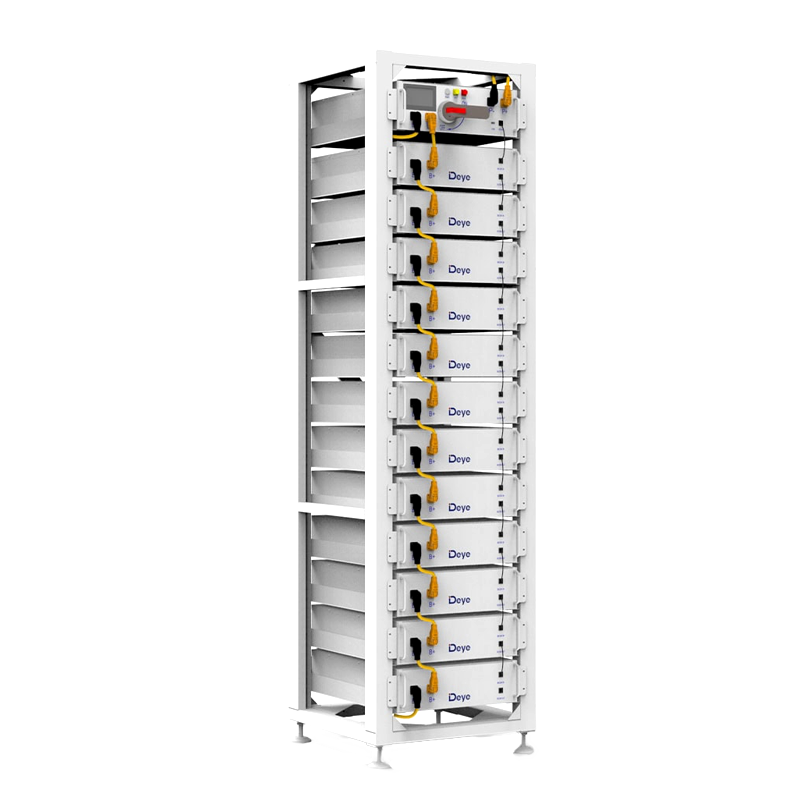 Deye BOS-G High Voltage Battery SystemA modular high‑voltage LFP battery platform aimed at small‑scale commercial and industrial storage deployments where scalability and system voltage matter. BOS‑G is de...View Product →
Around the BMS sit the electrical protections: correctly sized DC breakers or fuses, cable cross-sections matched to expected current, a means of isolation for service work, and a properly rated enclosure. Ventilation, spacing from combustible materials and clear labelling for emergency responders complete the picture. Skipping any of these because "LFP is safe anyway" is the most common mistake we see in the field.
Are LFP Batteries Safe Indoors and at Home?
For residential storage, LFP is the chemistry we recommend almost without exception. A modern low-voltage unit is a sealed, maintenance-free enclosure with an integrated BMS, designed for wall or floor mounting in a garage, utility room or technical cupboard. Because there is no liquid electrolyte to top up and no venting in normal operation, indoor installation is straightforward when the manufacturer's clearance and ambient temperature limits are respected.
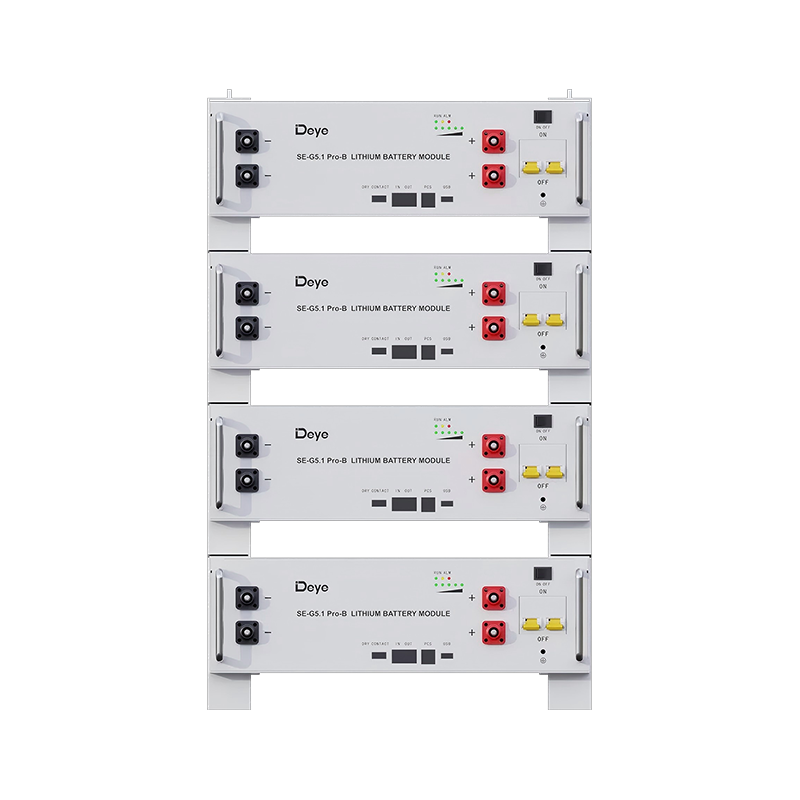 Deye SE-G5.1 Pro B LV batteryThe SE-G5.1 Pro B LV Battery is a compact and versatile lithium energy storage module designed for flexible integration into residential solar systems and small-scale ...View Product →
A few practical rules still apply: avoid stacking units in unventilated cupboards, keep them away from ignition sources and standing water, and never bypass the BMS to squeeze out extra capacity. Treated properly, a quality LFP battery will outlast the solar array it is paired with.
Commercial and Industrial Installations Need More Design Work
Scale changes the risk profile. A 215 kWh or 430 kWh cabinet holds many more cells in a much smaller footprint, so fire detection, suppression, thermal barriers between racks and clear separation distances become part of the design rather than optional extras. Project approvals usually depend on pack-level test evidence as well as cell-level certificates, and local fire codes set the final rules on placement and clearance.
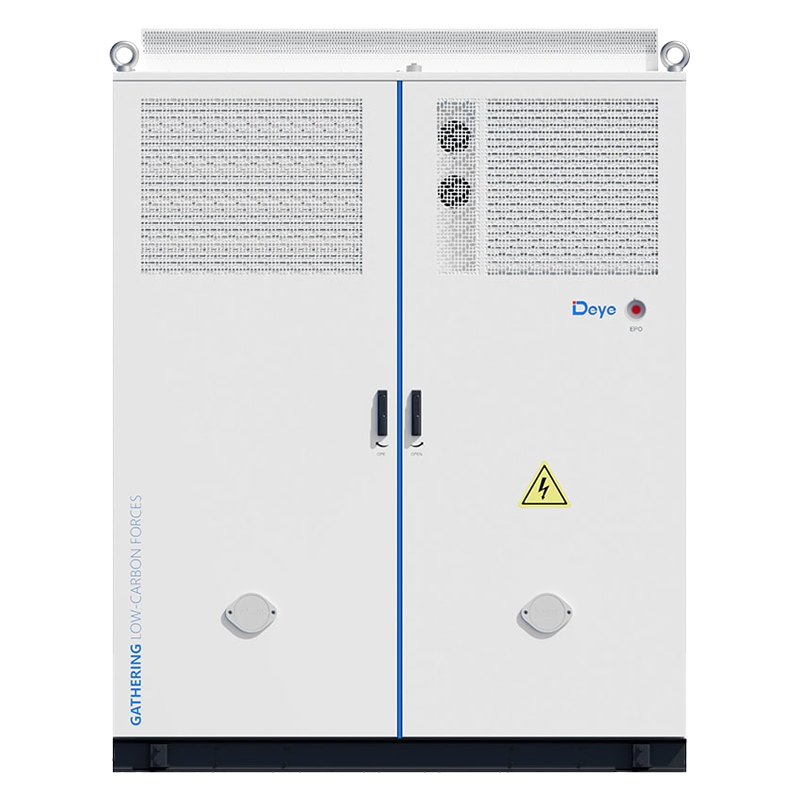 Deye MC-L430-2H3 All‑in‑One C&I Energy Storage SystemAn all‑in‑one, high‑voltage commercial industrial energy storage cabinet designed to solve real C I problems: peak‑shaving, PV self‑consumption, demand charge reductio...View Product →
In our experience, the safest commercial projects are the ones where the storage supplier, the inverter supplier and the EPC contractor agree on the protection scheme before the first cabinet is unpacked.
Common Myths About LFP Safety
- "LFP never catches fire." It is far more resistant, and cell-level fires are rare, but a damaged or abused pack can still vent hot gas.
- "Any BMS will do." Protection thresholds, temperature sensing and balancing quality vary enormously between suppliers, and cheap electronics are where corners are usually cut.
- "Temperature does not matter." LFP tolerates heat better than nickel-rich cells, yet sustained operation outside the rated window still shortens life and raises risk.
- "Certification is bureaucracy." Test reports are how you verify that a specific product, not a chemistry in general, has been validated.
What to Verify Before You Buy
Whether you are equipping one home or a portfolio of commercial sites, a short checklist removes most of the uncertainty:
- Ask for cell-level and pack-level test documentation, not a general chemistry description.
- Review the BMS specification: voltage window, temperature cut-offs, balancing method and communication protocol.
- Confirm closed-loop compatibility between the battery and the chosen hybrid inverter.
- Check the enclosure IP rating, mounting clearance and permitted ambient temperature range.
- Verify that spare parts, firmware updates and technical documentation will still be available in five years.
If you want to compare storage options on equal terms, our explainer on the benefits of energy storage battery technology walks through the practical differences between battery types in real projects.
Frequently Asked Questions
Do LFP batteries catch fire?
They can, but it is uncommon and usually requires a serious fault such as internal short circuit, severe overcharge or physical damage. Unlike nickel-rich cells, the cathode does not readily supply oxygen, so a fire rarely sustains itself or spreads between cells.
Are LFP batteries safe to install inside a home?
Yes, when installed to the manufacturer's instructions. Modern residential units are sealed and include an integrated BMS, and thousands of LFP systems operate indoors in Europe and North America without incident.
How long do LFP batteries last?
Most quality products are rated for 4,000 to 6,000 full cycles before dropping to 80% of original capacity, which typically translates to ten years or more in normal residential duty.
Do LFP batteries comply with fire safety codes?
Compliance depends on the product and the project. Reputable manufacturers publish test reports against recognised standards, and installations must still meet local fire and electrical regulations.
So, are lithium iron phosphate batteries safe? Yes, and for most storage applications they are the safest practical choice available today. The chemistry removes the most dangerous failure mode of lithium-ion technology, but it does not remove the need for good engineering. Choose a supplier who can show you test evidence, explain the BMS in plain language and support the system after commissioning, and LFP storage will comfortably do its job for the lifetime of your solar investment.








3+ Branch Offices
1+ Factory
Required fields are marked


Copyright @ Hangzhou Seetek New Energy Sci-tech Co., LtD. All rights reserved Solar Energy Storage Solution Solar Energy Storage Products Supplier
